

| Name | Flamuri i Shqipërisë Kuq e Zi (“the Red and Black”) |
|---|---|
| Adopted | November 28, 1912 (independence) April 7, 1992 (star removed) July 22, 2002 (standardized) |
| Proportion | 7 5 5 |
| Flag Day | November 28 |
| The Albanian flag is a red field with a black double-headed eagle in the center — the design the Constitution names and Law No. 8926 of 2002 fixes in detail, down to the nine feathers on each wing. | |
| |
An overview
The national flag of Albania is a red field with a black double-headed eagle in its center. The Constitution of 1998 defines it in one sentence, and Law No. 8926 of July 22, 2002, fixes every detail: a blood-red field in a 5:7 ratio, the eagle centered with open wings, nine feathers on each wing and seven on the tail.
It is among the oldest flag designs still flown. The eagle comes from the arms of the Kastrioti family of Gjergj Kastrioti — Skanderbeg — who raised it over the fortress of Krujë on November 28, 1443, at the start of his 25-year resistance against the Ottoman Empire. When Ismail Qemali proclaimed independence at Vlorë on November 28, 1912, the same red flag with the black eagle went up, and every Albanian state since has kept it. Only the emblems above the eagle’s heads — a star, a helmet, fasces — have come and gone with the governments that added them.
Albanians call the flag Kuq e Zi, “the Red and Black,” and the country’s own name in Albanian, Shqipëria, is popularly linked to shqiponja, the eagle.
The double-headed eagle
The double-headed eagle reached Albania through Byzantine heraldry, where it stood for imperial authority. Albanian noble houses of the late Middle Ages — the Kastrioti among them — took it into their own arms, and Skanderbeg’s revolt made the Kastrioti version the emblem of Albanian resistance. Nationalists of the late 19th century, including the writers Faik Konitza in Brussels and Qerim Panarity in Boston, revived Skanderbeg and his flag as the rallying symbol of the independence movement.
The statutory eagle is precise: two heads turned outward, wings open, nine feathers on each wing, seven on the tail — a silhouette in solid black, drawn in the appendix to Law No. 8926. The modern rendering is attributed to the painter Sadik Kaceli.
Design and official specification
Law No. 8926 of July 22, 2002 — the statute on the national flag, the anthem, and the coat of arms — declares the flag a national symbol and fixes its form. The field is blood red, the eagle black and centered, and the flag’s height-to-length ratio is 1:1.4, that is, 5:7. The law’s appendix carries the reference artwork and color strengths and is an integral part of the statute.
| Element | Specification | Reference |
|---|---|---|
| Hoist (height) | 1.0 | 100 cm (39.4 in) |
| Fly (length) | 1.4 | 140 cm (55.1 in) |
| Ratio | 5 : 7 (1 : 1.4) | Article III |
| Field | Blood red | Article III |
| Eagle | Black, two heads, open wings, centered | Article III |
| Feathers per wing | 9 | Article III |
| Tail feathers | 7 | Article III |
Official color specification
The flag uses two colors. The appendix to Law No. 8926 gives the red as pure red — #FF0000, CMYK 0-100-100-0 — and the eagle as solid black. The law names no Pantone number, and Pantone matches used for the flag vary between references.
| Color | HEX | RGB | Pantone |
|---|---|---|---|
| Red | #FF0000 | 255, 0, 0 | — |
| Black | #000000 | 0, 0, 0 | — |
Symbolism and meaning
Albanian law defines the flag’s form, not its meaning. The readings below are the traditional ones, repeated across Albanian public life and standard references.
The eagle itself is older than any of these readings: it entered Albanian heraldry from Byzantium and has marked Albanian identity since the Middle Ages.
How the flag evolved
The core design has not changed since Skanderbeg: a black double-headed eagle on red. What changed, regime by regime, is the device above the eagle’s heads — added by principality, kingdom, occupation, and people’s republic in turn, and removed each time. Since 1992 there has been nothing above the eagle at all.
-
1443
Skanderbeg's standard

On November 28, 1443, Gjergj Kastrioti — Skanderbeg — raised his standard over the fortress of Krujë in revolt against Ottoman rule. His family arms, a black double-headed eagle on red, held off the empire for a quarter century and became the lasting symbol of Albania.
-
1912
Independence

On November 28, 1912 — 469 years to the day after Krujë — Ismail Qemali proclaimed Albania's independence from the Ottoman Empire at Vlorë and raised the red flag with the black eagle. November 28 has been Flag Day ever since.
-
1914
Principality

The short-lived principality flew the eagle with a star above its heads — the first in a series of emblems that governments would add over the eagle and later remove.
-
1920
Plain eagle restored

After World War I the republic returned to the plain design: the black double-headed eagle on red, with no device above it.
-
1928
Kingdom

Under King Zog I the golden helmet of Skanderbeg was set above the eagle — the same helmet that tops the state coat of arms today.
-
1939
Italian occupation

During the Italian occupation the eagle was flanked by fascist fasces. The device disappeared with the occupation itself.
-
1946
Communist star

The People's Republic placed a five-pointed red star, bordered in gold, above the eagle's heads. The 1976 constitution wrote that design into law, and it flew until the regime fell.
-
1992
The star comes down
On April 7, 1992, the first post-communist Assembly voted the star off the flag, returning to the plain eagle on red. Law No. 8926 of July 22, 2002, standardized the design in force today.
Who designed the Albanian flag?
No single designer is credited, because the design was inherited, not commissioned: it descends from the Kastrioti family arms that Skanderbeg carried from 1443. The modern standardized rendering of the eagle is attributed to the painter Sadik Kaceli.
The flag raised at Vlorë on November 28, 1912, has its own small mystery. Accounts from the period say it was sewn by Marigo Posio; a 1937 account describes a cloth about 3 meters by 2 meters (9.8 by 6.6 feet). But Albania’s Center for Albanological Studies notes there is no definitive record of how that first flag actually looked.
Flag Day, November 28
November 28 is Dita e Flamurit — Flag Day — and the Constitution names it the National Holiday of the Republic. It marks the proclamation of independence at Vlorë on November 28, 1912, and, by tradition, the raising of Skanderbeg’s standard at Krujë on the same date in 1443. Even the national anthem points at the flag: its title, Himni i Flamurit, means “Hymn to the Flag.”
Legal status and display rules
The flag’s status rests on two texts. Article 14 of the Constitution defines the national flag as red with a black two-headed eagle in the center. Law No. 8926 of 2002 fixes the form and dimensions and sets out how the flag is used.
Under the law, every Albanian citizen has the right to hold, raise, and use the national flag. Public institutions are obliged to display it inside or outside their buildings. Foreign flags may be raised only at receptions, protocol ceremonies, and other occasions provided by law — always accompanied by the national flag, which may not be smaller than the others and takes the most visible place. During national mourning declared by the Council of Ministers, the flag is flown at half-mast.
Things you may not know
The two great dates match. Skanderbeg raised his standard at Krujë on November 28, 1443; Albania declared independence at Vlorë on November 28, 1912 — 469 years apart to the day. One Flag Day covers both.
The feathers are counted by statute. Law No. 8926 does not just describe an eagle — it prescribes nine feathers on each wing and seven on the tail. A flag with the wrong count is, strictly, not the national flag.
The eagle may be the country’s name. Albanians call their country Shqipëria and themselves shqiptarë, names popularly connected to shqiponja — the eagle. The bird on the flag and the land it flies over may share a name.
-
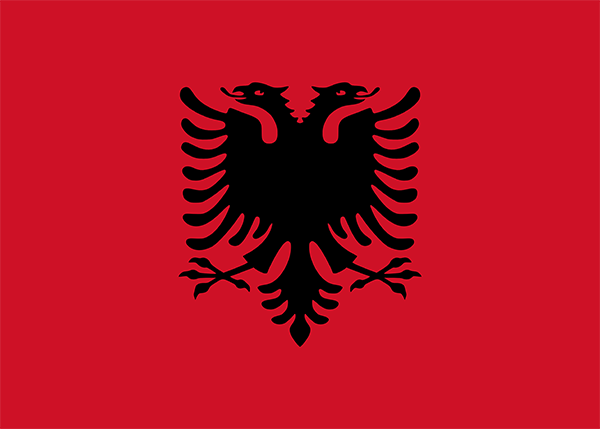
Albania Flag— code
-

Albania Flag— code
DownloadsRequest a high-resolution image
- Browse the images above and tap the code beneath the one you want — it copies to your clipboard.
- In the form below, enter your email and paste the code along with a short note telling us what you need.
- We'll email you the requested image, usually within a few business days.
Frequently asked questions
What does the flag of Albania look like?
The flag of Albania is a red field with a black double-headed eagle in the center. The Constitution defines it in exactly those terms, and Law No. 8926 of 2002 fixes the details: a blood-red field, the eagle with open wings, nine feathers on each wing and seven on the tail, in a 5:7 ratio.
What does the double-headed eagle on the Albanian flag mean?
The eagle is the national symbol of the Albanians. It comes from the arms of the Kastrioti family of the national hero Skanderbeg, who raised it against the Ottomans in 1443, and ultimately from the double-headed eagle of Byzantine heraldry. The two heads are commonly read as vigilance, looking east and west at once.
What do the colors of the Albanian flag mean?
No official meaning is written into law. The red field is traditionally read as the bravery and sacrifice of Albanians through centuries of foreign rule, and the black eagle as sovereignty and the legacy of Skanderbeg's resistance.
When was the Albanian flag adopted?
The red flag with the black double-headed eagle has been Albania's national flag since independence was proclaimed on November 28, 1912. The current plain version dates to April 7, 1992, when the star of the communist era was removed, and the design was standardized by Law No. 8926 on July 22, 2002.
Why is there no star on the Albanian flag anymore?
The gold-bordered red star above the eagle was the emblem of the communist People's Republic, added in 1946. After the regime fell, the newly elected Assembly voted on April 7, 1992, to remove it and restore the plain eagle on red.
Who designed the Albanian flag?
No single designer is credited: the design descends from the arms of the Kastrioti family, used by Skanderbeg from 1443. The modern rendering of the eagle is attributed to the painter Sadik Kaceli.
What are the official proportions and colors of the Albanian flag?
Law No. 8926 of 2002 sets the ratio at 5:7 (1:1.4) and fixes the artwork in its appendix: a blood-red field (given as #FF0000, CMYK 0-100-100-0) and a black eagle (#000000) with nine feathers per wing and seven tail feathers. The law names no Pantone number.
When is Albania's Flag Day?
Flag Day (Dita e Flamurit) is November 28, the anniversary of the 1912 declaration of independence at Vlorë — and, by tradition, of the day Skanderbeg raised his standard at Krujë in 1443. The Constitution makes it the National Holiday of the Republic.
What are the rules for displaying the Albanian flag?
Law No. 8926 gives every Albanian citizen the right to hold, raise, and use the national flag, and obliges public institutions to display it. Foreign flags may be flown only alongside the national flag and may not be larger. The flag is flown at half-mast during national mourning declared by the Council of Ministers.

We Value Your Opinion Comments