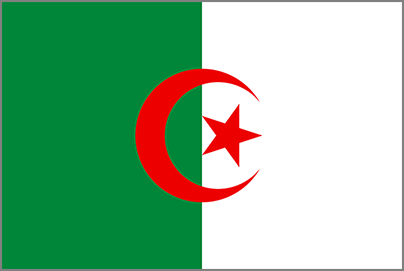

| Name | ʿAlam al-Jazāʾir (علم الجزائر — Flag of Algeria) |
|---|---|
| Adopted | July 3, 1962 (independence) April 25, 1963 (standardized, Law No. 63-145) |
| Proportion | 3 2 2 |
| Status | Immutable (Constitution, Article 5) |
| The Algerian flag is two equal vertical bands of green and white bearing a red crescent and five-pointed star — a design the 1963 law fixes down to the wavelength of its colors, and the Constitution declares unchangeable. | |
| |
An overview
The national flag of Algeria is a rectangle of two equal vertical bands — green at the hoist, white at the fly — bearing a red crescent and a red five-pointed star centered on the line between them. The ratio is 2:3, and the star sits entirely on the white band.
The design came out of the nationalist movement of the early 20th century, was carried through the war of independence by the National Liberation Front, and was raised over an independent Algeria on July 3, 1962. Law No. 63-145 of April 25, 1963, fixed its characteristics in an annex of unusual precision: the colors are defined by wavelength and the crescent and star by exact geometry. The Constitution goes further still — Article 5 declares the emblem a conquest of the November 1, 1954 Revolution and immutable.
The flag serves on land and at sea alike, as national flag, civil flag, and ensign; only the National Navy adds a mark of its own, two white crossed anchors in the upper hoist.
The crescent and star
The crescent and five-pointed star are the oldest elements of the design — symbols of Islam long flown across North Africa and by the dynasties that ruled in Algeria. On the flag they are drawn to statute: the crescent’s outer circle is centered on the exact center of the rectangle, its tips open across five-sixths of that circle, and the star is inscribed in a circle one-eighth of the flag’s height, two of its points resting on the vertical dividing line.
The star’s five points are commonly read as the five pillars of Islam. The historian Benjamin Stora has suggested the three colors originally stood for the three countries of the Maghreb and the idea of their union.
Design and official specification
Law No. 63-145 of April 25, 1963 — signed by President Ahmed Ben Bella — declares the national emblem a green and white flag bearing a red star and crescent, and fixes every detail in its annex. The rectangle’s length is one and a half times its height; the field is divided along the short median into a green half against the staff and a white half at the fly.
| Element | Specification | Reference |
|---|---|---|
| Hoist (height) | 1.0 | 100 cm (39.4 in) |
| Fly (length) | 1.5 | 150 cm (59.1 in) |
| Ratio | 2 : 3 (1 : 1.5) | Annex, Law No. 63-145 |
| Field | Two equal vertical bands — green at the hoist, white at the fly | Annex |
| Crescent, outer circle | Radius = 1/4 of the height | 25 cm (9.8 in) |
| Crescent, inner circle | Radius = 1/5 of the height | 20 cm (7.9 in) |
| Crescent opening | Tips span 5/6 of the outer circle | Annex |
| Star | Five points, in a circle of radius 1/8 of the height | 12.5 cm (4.9 in) |
| Star position | Entirely on the white band; two points on the vertical median, one on the horizontal | Annex |
Official color specification
The law defines the two hues physically rather than by swatch. The green must be an equal composition of yellow and blue with a wavelength of 5,411 ångströms; the red must be a pure, indecomposable primary color, free of blue and yellow, at 6,562 ångströms — both per the Rood contrast diagram named in the annex. The values below are the modern matches commonly cited in standard references.
| Color | HEX | RGB | Pantone |
|---|---|---|---|
| Green | #007A33 | 0, 122, 51 | 356 C |
| White | #FFFFFF | 255, 255, 255 | — |
| Red | #C8102E | 200, 16, 46 | 186 C |
Symbolism and meaning
Algerian law fixes the flag’s form, not its meaning. The readings below are the traditional ones, repeated across Algerian public life and standard references.
The colors carried these associations in the nationalist movement decades before independence — the flag’s meaning was fixed by history before its form was fixed by law.
How the flag evolved
The Algerian flag was a protest banner before it was a state symbol. Its exact origin is disputed — the record offers a 1934 sewing, May Day marches from 1919, and more than one claimed designer — but its path from the nationalist movement through the war of independence to the law of 1963 is documented step by step.
-
1830s
Abdelkader's standard

Tradition credits Emir Abdelkader, leader of the resistance to the French invasion, with a green and white standard that inspired the modern flag. Evidence for the attribution is lacking, but later nationalists invoked him as the flag's forefather.
-
1926
The ENA's first emblem

The North African Star (ENA), the nationalist association led by Messali Hadj — with Abdelkader's grandson Khaled among its members — flew a green flag carrying the motto "Algeria our country, Arabic our language and Islam our religion."
-
1934
Green, white and red

By most accounts the colors were chosen at an ENA meeting in 1934, and Émilie Busquant, the French wife of Messali Hadj, sewed the first flag. Historians dispute the origin: green-and-white flags with the red crescent and star are also reported in May Day marches as early as 1919, and the designer Chawki Mostefaï is credited by others.
-
1945
The May 1945 flag

The flag in its present form was carried at the May 1945 independence demonstrations. At Sétif on May 8 it was borne by Bouzid Saâl, who was shot by police — and that flag became the model the movement carried forward.
-
1958
Government in exile

The National Liberation Front (FLN) carried the flag through the war of independence, and the provisional government in exile (GPRA) adopted it in 1958. Hoisted at the Monrovia conference in 1959, it was recognized by several African states before independence.
-
1962
Independence
The flag was raised over an independent Algeria on July 3, 1962. Law No. 63-145, signed by President Ahmed Ben Bella on April 25, 1963, fixed its characteristics in an annex — and the design has not changed since.
Who designed the Algerian flag?
No designer is settled. The most cited account, from the historian Benjamin Stora, has the colors chosen at a 1934 meeting of the North African Star movement, with Émilie Busquant — the French labor activist married to the movement’s leader, Messali Hadj — sewing the first flag. Other historians, led by René Gallissot and Anissa Bouayed, trace green-and-white flags with the red crescent and star to Algerian marches as early as May Day 1919, and the physician and militant Chawki Mostefaï is also credited with the design.
What is certain is where the final form was carried: the flag of the May 1945 demonstrations became the flag of the National Liberation Front, of the government in exile, and — unchanged — of the republic.
Legal status and display rules
The flag’s status rests on two texts. Article 5 of the Constitution declares the national emblem and anthem “conquests of the November 1, 1954 Revolution” and immutable — no ordinary law can change the flag. Law No. 63-145 of 1963 defines its form, colors, and geometry.
The flag flies on public and military buildings, on Algeria’s embassies and missions abroad, in school classrooms, and at national commemorations, where it is rendered formal honors. Its protection is penal: Article 160 bis of the Penal Code punishes anyone who deliberately and publicly tears, defaces, or desecrates the flag with 5 to 10 years’ imprisonment.
Things you may not know
The colors are defined in ångströms. The 1963 law specifies the green and red not by swatch but by physics — wavelengths of 5,411 and 6,562 ångströms on the Rood contrast diagram. Few flag laws anywhere read like an optics textbook.
A hand almost made the flag. The Hand of Fatima (khamsah), a silhouetted hand long popular on Algerian banners, appeared with a yellow ring in a green-white-green flag proposed in the 1940s by a rival nationalist party — but it was left off the flag of 1962.
The flag cannot be changed. The Constitution declares the emblem immutable — a status few national flags hold. Amending the design would require touching the constitutional text itself.
-
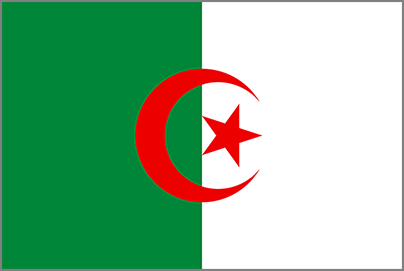
Algeria Flag— code
-
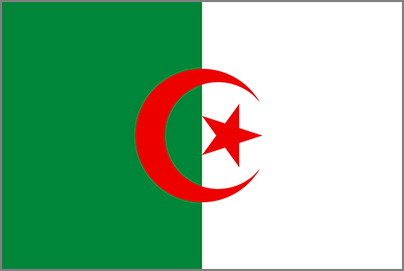
Algeria Flag— code
DownloadsRequest a high-resolution image
- Browse the images above and tap the code beneath the one you want — it copies to your clipboard.
- In the form below, enter your email and paste the code along with a short note telling us what you need.
- We'll email you the requested image, usually within a few business days.
Frequently asked questions
What does the flag of Algeria look like?
The flag of Algeria is a rectangle of two equal vertical bands — green at the hoist, white at the fly — with a red crescent and a red five-pointed star centered on the dividing line. The ratio is 2:3, and the star sits entirely on the white band.
When was the Algerian flag adopted?
The flag was raised over an independent Algeria on July 3, 1962, after serving as the flag of the National Liberation Front and of the provisional government in exile from 1958. Law No. 63-145 of April 25, 1963, made it official and fixed its exact characteristics.
Who designed the Algerian flag?
The origin is disputed. By the most cited account, the colors were chosen at a 1934 meeting of the North African Star movement and Émilie Busquant, wife of the nationalist leader Messali Hadj, sewed the first flag. Other historians trace green-and-white flags with the red crescent and star to May Day marches as early as 1919, and some credit the designer Chawki Mostefaï.
What do the colors of the Algerian flag mean?
No official meaning is written into law. Green is traditionally read as Islam and hope, white as purity and peace, and red as the blood of the martyrs of the war of independence (1954–1962).
What do the crescent and star on the Algerian flag mean?
The crescent and five-pointed star are traditional symbols of Islam, long used across North Africa and by the dynasties that ruled in Algeria. The star's five points are commonly read as the five pillars of Islam.
What are the official proportions and specifications of the Algerian flag?
The annex to Law No. 63-145 sets the ratio at 2:3 and defines the geometry exactly: the crescent's outer circle has a radius of one-quarter of the flag's height and its inner circle one-fifth, the crescent's tips span five-sixths of the outer circle, and the star is inscribed in a circle of radius one-eighth of the height, with two points on the vertical median and one on the horizontal.
What are the official colors of the Algerian flag?
The law defines them physically: the green is an equal mix of yellow and blue with a wavelength of 5,411 ångströms, and the red is a pure primary color at 6,562 ångströms, both per the Rood contrast diagram. Modern references commonly match these as #007A33 (Pantone 356 C) and #C8102E (Pantone 186 C).
What is the legal status of the Algerian flag?
Article 5 of the Constitution declares the national emblem and anthem "conquests of the November 1, 1954 Revolution" and immutable — the flag cannot be changed. Article 160 bis of the Penal Code punishes anyone who deliberately and publicly tears, defaces, or desecrates the flag with 5 to 10 years' imprisonment.
Is the Algerian naval ensign different from the national flag?
Slightly. Algerian ships fly the national flag, but vessels of the National Navy use a version with two white crossed anchors in the upper hoist canton.

We Value Your Opinion Comments