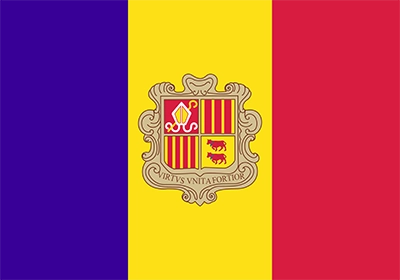

| Name | Bandera d'Andorra (Catalan — Flag of Andorra) |
|---|---|
| Adopted | 1866 (tricolor, traditional) July 1993 (standardized, UN accession) |
| Proportion | 10 7 7 |
| Status | Traditional symbol (Constitution, Article 2.2) |
| The Andorran flag is a vertical blue-yellow-red tricolor bearing the national coat of arms on its slightly wider yellow band — the colors of France and Spain meeting on the flag of the Pyrenean co-principality. | |
| |
An overview
The national flag of Andorra is a vertical tricolor of blue, yellow, and red with the national coat of arms centered on the yellow band. The bands are not quite equal: the yellow is slightly wider, at a ratio of 8:9:8, and the flag as a whole is 7:10.
The design reflects the country’s singular position. Andorra is a co-principality in the Pyrenees whose two heads of state are, to this day, the Catholic bishop of Urgell in Spain and the president of France — and its flag is generally read as joining the blue and red of France with the red and yellow of Spain and Catalonia. The tricolor is said to date from 1866; the 1993 Constitution declared the traditional flag and arms the symbols of the state, and the design was standardized that July, when Andorra joined the United Nations.
A plain version without the arms — the original 1866 design — remains the civil flag, though its near-identity to the flags of Romania and Chad keeps it rarely flown.
The coat of arms
The shield at the flag’s center is Andorra’s history in four quarters: the mitre and crosier of the bishop of Urgell; the three red bars on gold of the count of Foix, whose rights passed in time to the French head of state; the four red bars on gold of Catalonia; and the two red cows of Béarn. The first two quarters are the two co-princes — the arrangement created in 1278, when bishop and count agreed to share jurisdiction over the valleys.
Beneath the shield runs the Latin motto Virtus Unita Fortior — “strength united is stronger.” A centuries-old carving of these arms survives on the wall of the Casa de la Vall, the historic seat of Andorra’s parliament, the General Council.
Design and official specification
The standardized design sets the flag at 7:10 with three vertical bands — blue at the hoist, yellow, red at the fly — in widths of 8:9:8, the wider yellow band carrying the coat of arms. The state flag bears the arms; the civil flag omits them.
| Element | Specification | Reference |
|---|---|---|
| Hoist (height) | 0.7 | 70 cm (27.6 in) |
| Fly (length) | 1.0 | 100 cm (39.4 in) |
| Ratio | 7 : 10 | Standardized design |
| Bands | Three vertical — blue at the hoist, yellow, red at the fly | — |
| Band widths | 8 : 9 : 8 (yellow slightly wider) | 32 / 36 / 32 cm (12.6 / 14.2 / 12.6 in) |
| Coat of arms | Centered on the yellow band | State flag only |
| Civil flag | The plain tricolor, without arms | In use since 1866 |
Official color specification
The official colors are set out in the “Graphic regulations for reproducing the shield and flag,” issued through the Oficina de Marques del Principat d’Andorra and approved by the Government of Andorra on May 5, 1999. Three Pantone colors define the bands; a fourth, a khaki, appears in the coat of arms.
| Color | HEX | RGB | Pantone |
|---|---|---|---|
| Blue | #10069F | 16, 6, 159 | Blue 072 C |
| Yellow | #FEDD00 | 254, 221, 0 | Yellow C |
| Red | #D50032 | 213, 0, 50 | 199 C |
| Khaki (arms) | #C6AA76 | 198, 170, 118 | 466 C |
Symbolism and meaning
No official meaning for the colors is written into law. The standard reading — the one Andorra’s geography makes hard to resist — is that the flag joins the colors of its two protecting neighbors.
The symbolism is embodied rather than decreed: the two co-princes named in the Constitution are the successors of the bishop and the count whose arms share the shield.
How the flag evolved
For a flag of a very old country, the record is surprisingly thin: the tricolor appears in 1866 with no known legal act behind it, drifts between vertical and horizontal for decades, and acquires its arms and exact form only in living memory.
-
1866
The tricolor appears

The blue-yellow-red tricolor is said to date from 1866, the year of the New Reform led by Guillem d'Areny-Plandolit — who may be its real creator, though tradition attributes the design to Napoleon III, France's emperor and co-prince. No first legal authority for it is known. That plain tricolor is still Andorra's civil flag today.
-
c. 1900
Horizontal variants

From the late 19th century into the 1930s the same colors often flew in horizontal stripes — a travel account from 1898 describes a horizontal flag hanging from the parliament during sessions. Why the arrangement varied is not recorded.
-
c. 1939
Vertical, with the arms

Around 1939 the vertical arrangement returned, now carrying a coat of arms on the yellow band. For decades afterward the flag's details — the arms, the proportions — varied from maker to maker.
-
1993
Standardized
Andorra's new Constitution declared the traditional flag and arms the symbols of the state, and the design was standardized in July 1993, when Andorra joined the United Nations. The government's graphic regulations of May 5, 1999, fixed the exact colors.
Who designed the Andorran flag?
No designer is settled. Tradition attributes the tricolor to Napoleon III — emperor of France and, by that office, co-prince of Andorra — with the blue stripe standing for France. Its adoption coincided with the New Reform of 1866, the modernization led by Guillem d’Areny-Plandolit, who may be the flag’s real creator; the reform was approved by the episcopal co-prince, Bishop Josep Caixal i Estradé, that April, and by Napoleon III three years later.
Britannica’s dry verdict stands for the whole early record: the flag is said to date from 1866, but the first legal authority for it is unknown.
Legal status and display rules
The flag’s modern status rests on the Constitution of 1993, approved by referendum on March 14 of that year. Article 2.2 is brief: the national anthem, the state flag, and the coat of arms of Andorra “are the traditional ones.” The design was standardized in July 1993, when Andorra was admitted to the United Nations, and a 1996 law on the use of the signs of the state governs their official use.
The exact reproduction of flag and arms — colors, proportions, artwork — is fixed by the graphic regulations of May 5, 1999. The state flag with the arms is the one flown officially; the plain tricolor remains available as the civil flag.
Things you may not know
The yellow band is wider. Look closely: the bands run 8:9:8, not equal thirds. The slightly broader middle band makes room for the coat of arms — and it is one of the quickest ways to tell Andorra’s flag from Romania’s or Chad’s.
Two flags in the world carry cattle. The red cows of Béarn make Andorra one of only two national flags to portray cattle — the other is Moldova’s, whose arms carry an aurochs head and whose flag is Andorra’s closest look-alike.
Its heads of state are on the shield. The bishop’s mitre and the count’s bars in the arms aren’t just history — the bishop of Urgell and the successor to the count’s rights, the president of France, are Andorra’s co-princes today, an arrangement dating to 1278.
-

Andorra Flag— code
-
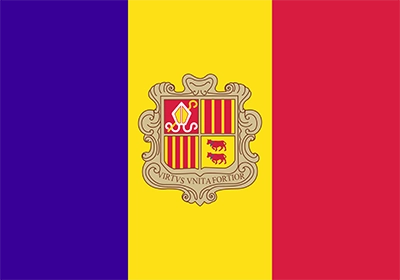
Andorra Flag— code
DownloadsRequest a high-resolution image
- Browse the images above and tap the code beneath the one you want — it copies to your clipboard.
- In the form below, enter your email and paste the code along with a short note telling us what you need.
- We'll email you the requested image, usually within a few business days.
Frequently asked questions
What does the flag of Andorra look like?
The flag of Andorra is a vertical tricolor of blue, yellow, and red with the national coat of arms centered on the yellow band. The yellow band is slightly wider than the other two — the band widths run 8:9:8 — and the overall ratio is 7:10.
When was the Andorran flag adopted?
The tricolor is said to date from 1866, though no first legal authority for it is known. The 1993 Constitution declared the traditional flag a symbol of the state, the design was standardized in July 1993 when Andorra joined the United Nations, and the official colors were fixed by the government's graphic regulations of May 5, 1999.
Who designed the Andorran flag?
The authorship is disputed. Tradition attributes the design to Napoleon III, France's emperor and co-prince of Andorra, with the blue stripe representing France. Its appearance coincided with the New Reform of 1866 led by Guillem d'Areny-Plandolit, who may be the real creator.
What do the colors of the Andorran flag mean?
No official meaning is written into law. The colors are generally read as joining those of Andorra's two protecting neighbors — the blue and red of France with the red and yellow of Spain and Catalonia — reflecting the co-principality's position between them.
What is on the coat of arms of the Andorran flag?
A quartered shield bearing the arms of four houses: the mitre and crosier of the bishop of Urgell, the three red bars on gold of the count of Foix, the four red bars on gold of Catalonia, and the two red cows of Béarn. Beneath it runs the Latin motto Virtus Unita Fortior — "strength united is stronger."
What are the official proportions of the Andorran flag?
The overall ratio is 7:10. The three vertical bands are not equal: the widths run 8:9:8, making the yellow band with the coat of arms slightly wider than the blue and red bands.
What are the official colors of the Andorran flag?
The graphic regulations approved by the Government of Andorra on May 5, 1999, fix them as Pantone Blue 072 C (#10069F), Pantone Yellow C (#FEDD00), and Pantone 199 C red (#D50032), with a khaki, Pantone 466 C, appearing in the coat of arms.
How is the Andorran flag different from the flags of Romania, Chad, and Moldova?
All four are blue-yellow-red vertical tricolors. Andorra's is set apart by its coat of arms on the yellow band, its wider middle band (8:9:8), and its 7:10 ratio. Moldova is the closest match — it also carries central arms — while Romania and Chad fly plain tricolors, like Andorra's own civil flag.
Does Andorra have a flag without the coat of arms?
Yes. The plain blue-yellow-red tricolor — the original 1866 design — remains the civil flag. Because it is nearly identical to the flags of Romania and Chad, it is rarely flown; the state flag with the arms is the one in general use.

We Value Your Opinion Comments