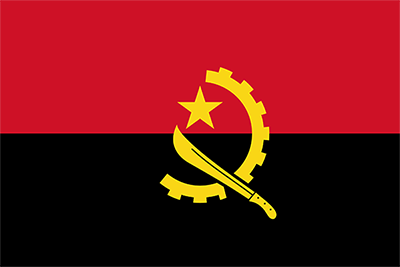

| Name | Bandeira de Angola (Portuguese — Flag of Angola) |
|---|---|
| Adopted | November 11, 1975 (independence) |
| Designer | Henrique de Carvalho Santos (credited; based on the MPLA flag) |
| Proportion | 3 2 2 |
| Status | Defined in the constitution (Annex I, design and meaning) |
| The Angolan flag is red over black under a yellow machete, half cogwheel, and star — the MPLA's liberation banner, adopted at independence in 1975 and carried unchanged into the current constitution. | |
| |
An overview
The national flag of Angola is a horizontal bicolor — a red band above a black band — charged in the center with a yellow emblem: a machete crossed by a half cogwheel and crowned with a five-pointed star. The ratio is 2:3.
It is a liberation movement’s banner made national. The MPLA carried red over black with a yellow star through the war of independence; at independence on November 11, 1975, the machete and cogwheel joined the star, and the party flag became the state flag. It has flown unchanged since — through the end of the People’s Republic in 1992, past a formal proposal to replace it in 2003, and into the constitution of 2010, whose Annex I defines both its design and, unusually among national flags, its official meaning.
The flag serves as national flag and ensign alike, and the president’s standard carries the same emblem — with two olive branches added — on a plain red field.
The machete, the cogwheel, and the star
The yellow charge is the flag’s signature, and the constitution reads it precisely: the machete is the peasants, agriculture, and the war of independence; the half cogwheel is the workers and industry; the star is international solidarity and progress; the yellow itself is Angola’s wealth.
Its lineage is the socialist iconography of its era. Vexillologist Whitney Smith noted the emblem’s resemblance to the hammer, sickle, and star of the Soviet flag, and traced the flag’s probable model to the banner of the Viet Cong — red over light blue with a central yellow star — which liberation movements worldwide admired and which the MPLA adapted by setting the star on black, for the African people.
Design and official specification
Two texts govern the flag. Annex I of the constitution defines the design — the two bands and the emblem. Section 2.1 of the government’s manual of graphic and protocol standards for national symbols fixes its reproduction: the flag may be made in any size so long as the ratio is 2:3, and the emblem and bands must match the manual’s construction sheet — any other arrangement is treated as a distortion of the flag.
| Element | Specification | Reference |
|---|---|---|
| Hoist (height) | 1.0 | 100 cm (39.4 in) |
| Fly (length) | 1.5 | 150 cm (59.1 in) |
| Ratio | 2 : 3 | Manual, Section 2.1 — any size is acceptable at this ratio |
| Bands | Two equal horizontal — red above, black below | Constitution, Annex I |
| Charge | A yellow machete crossed by a half cogwheel, crowned with a five-pointed star, centered | Constitution, Annex I |
| Construction | Emblem and band placement must match the manual's construction sheet | Any other arrangement is a distortion |
Official color specification
The manual names the flag’s three colors — Angola red, Angola yellow, and process black — and fixes their shades. The red and yellow carry the country’s name in the standard itself.
| Color | HEX | RGB | Pantone |
|---|---|---|---|
| Angola red | #CC092F | 204, 9, 47 | 186 C |
| Angola yellow | #FFCB00 | 255, 203, 0 | 116 C |
| Process black | #000000 | 0, 0, 0 | Black 6 C |
Symbolism and meaning
Angola is one of the countries whose flag’s meaning is not tradition but law: Annex I of the constitution assigns each color and each element its significance.
The wording has softened with the state: in the original 1975 constitution the red stood for “revolution” and the star for “internationalism” — today it is the defense of the country, and international solidarity.
How the flag evolved
The design’s whole history spans one movement and one night: a guerrilla banner of the 1960s, a midnight proclamation in 1975 — and, since then, one serious attempt at replacement that the public turned down.
-
1960s
The MPLA banner

Through the war of independence (1961–1974) the Popular Movement for the Liberation of Angola flew red over black with a central yellow star. The probable model, by Whitney Smith's analysis, was the Viet Cong flag — with a black band for the African people in place of its light blue.
-
1975
Independence
At noon on November 10, 1975, the Portuguese flag came down in Luanda and sovereignty passed to the Angolan people. At midnight the MPLA proclaimed the People's Republic of Angola, and the party's banner — its star now joined by the machete and half cogwheel — became the national flag. It has flown unchanged since, outlasting the People's Republic itself: the state was renamed the Republic of Angola in 1992 with the flag untouched.
-
2003
The flag that never flew

After the civil war ended in 2002, a public competition for new symbols chose a design submitted as "Catica": red between white and blue bands, centered on a yellow sun drawn from the ancient rock paintings of Tchitundu-Hulu. Amid public disagreement it was never adopted — and the 2010 constitution carried the 1975 flag, its meanings gently reworded, into the present.
Who designed the Angolan flag?
Henrique de Carvalho Santos is credited with the design. His task was less invention than adaptation: the base was the MPLA’s existing red-over-black banner with its yellow star, to which the machete and half cogwheel were added for the national flag — labor and industry joining the movement’s star.
The party flag itself has a traceable ancestry: Whitney Smith identified the Viet Cong flag as its probable inspiration, its light blue exchanged for black to stand for the African people.
Legal status and display rules
The flag is defined in Annex I of the constitution and protected under Angolan law — improper use or handling of it is a criminal offense. The practical rules live in Section 2.1 of the national-symbols manual: any institution or individual may fly the flag under its protocols, and public institutions display it at their headquarters.
Government institutions raise the flag daily outside their headquarters; in general it flies on Sundays, public holidays, and days of official ceremony, and the president, the National Assembly, and the courts may order it raised on any other day. It is hoisted from 9 a.m. to sunset, illuminated by projectors where possible if flown at night. In periods of national mourning the flag — and any flag flown beside it — goes to half-mast, raised first to the top of the pole on the way down and again on the way back up.
Things you may not know
The meaning is law. Most flags accumulate their symbolism by tradition; Angola’s is assigned by the constitution itself, element by element — and the state has edited it. “Revolution” and “internationalism” in 1975 became “defense of the country” and “international solidarity” in the current text.
A new flag won a prize and never flew. After the civil war, a 2003 public competition selected a red, white, and blue design with a fifteen-ray sun drawn from the Tchitundu-Hulu rock paintings, submitted under the pseudonym Catica — a medal and a $20,000 award were announced. Public attachment to the independence flag kept it off the flagpoles.
The emblem names its era. A machete for the peasants, a cogwheel for the workers, a star above them — Whitney Smith’s comparison to the Soviet hammer, sickle, and star is hard to unsee, and the flag’s probable model, the Viet Cong banner, ties it to the liberation movements of its generation.
-

Angola Flag— code
-

Angola Flag— code
DownloadsRequest a high-resolution image
- Browse the images above and tap the code beneath the one you want — it copies to your clipboard.
- In the form below, enter your email and paste the code along with a short note telling us what you need.
- We'll email you the requested image, usually within a few business days.
Frequently asked questions
What does the flag of Angola look like?
The flag of Angola is a horizontal bicolor — a red band above a black band — charged in the center with a yellow emblem: a machete crossed by a half cogwheel and crowned with a five-pointed star. The ratio is 2:3.
When was the Angolan flag adopted?
On November 11, 1975, the day Angola became independent from Portugal and the MPLA proclaimed the People's Republic of Angola. The design has not changed since; the state was renamed the Republic of Angola in 1992 and the 2010 constitution retained the flag.
Who designed the Angolan flag?
Henrique de Carvalho Santos is credited with the design, which is based on the flag of the MPLA — the movement's red-over-black banner with a central yellow star — the party that has governed Angola since independence.
What do the colors of the Angolan flag mean?
The meanings are official — they are written into Annex I of the constitution. Red stands for the blood shed by Angolans during the colonial period, the war of independence, and in defense of the country; black represents Africa; and the yellow of the emblem symbolizes Angola's wealth.
What do the machete, cogwheel, and star on the Angolan flag mean?
Per the constitution, the machete represents the peasants, agriculture, and the war of independence; the half cogwheel represents the workers and industry; and the star stands for international solidarity and progress. In the original 1975 constitution the star stood for "internationalism" and the red for "revolution" — wording the current text has softened.
Is the Angolan flag based on the Soviet flag?
Not directly, though the resemblance is real: vexillologist Whitney Smith noted the machete, cogwheel, and star echo the hammer, sickle, and star of the Soviet flag. His analysis traces the flag's probable model to the Viet Cong flag — red over light blue with a yellow star — which the MPLA adapted by substituting black for the African people.
What are the official proportions and colors of the Angolan flag?
The ratio is 2:3 — the national-symbols manual accepts any size that keeps it. The manual names three colors: Angola red (Pantone 186 C, #CC092F), Angola yellow (Pantone 116 C, #FFCB00), and process black. The emblem's placement must match the manual's construction sheet; any other arrangement counts as a distortion.
Did Angola almost change its flag?
Yes. After the civil war ended in 2002, a public competition chose a new design — red, white, and blue bands with a yellow fifteen-ray sun based on the Tchitundu-Hulu rock paintings — submitted under the pseudonym Catica. Amid public disagreement over abandoning the independence flag, it was never adopted.
What are the rules for displaying the Angolan flag?
The manual's Section 2.1 lets any institution or individual fly the flag under its protocols. Government institutions raise it daily outside their headquarters; in general it flies on Sundays, public holidays, and days of official ceremony, hoisted from 9 a.m. to sunset and illuminated if flown at night. In national mourning it is flown at half-mast — raised to the top of the pole first — and improper use or handling of the flag is a criminal offense.

We Value Your Opinion Comments