| Adopted | February 27, 1967 (associated statehood) Retained November 1, 1981 (independence) |
|---|---|
| Designer | Sir Reginald Samuel (won a 600-entry competition) |
| Proportion | 3 2 2 |
| Sun | Golden, seven points (standardized 1994) |
| Use | National flag and civil ensign |
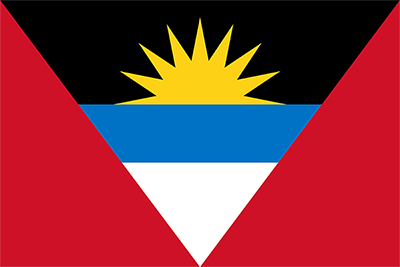
| The flag of Antigua and Barbuda sets a golden rising sun over black, blue, and white inside a red V — a schoolteacher's competition winner of 1967, carried unchanged into independence. | |
| |
An overview
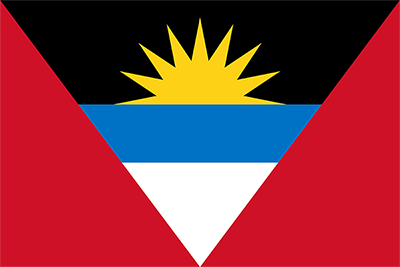
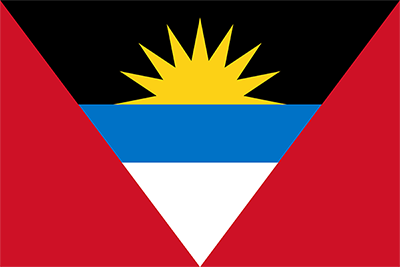
The national flag of Antigua and Barbuda is a red field with an inverted isosceles triangle spanning the full top edge and pointing to the bottom. Inside the triangle, three horizontal bands — black, blue at half width, and white — carry a golden sun rising on the black. The red field reads as two side triangles forming a V. The ratio is 2:3.
The design won a public competition of more than 600 entries and was first raised on February 27, 1967, the day Antigua became a state in free association with the United Kingdom. When full independence came on November 1, 1981, nothing changed: the flag was already the islands’ own. It serves as national flag and civil ensign; the coast guard’s state ensign sets it in the canton of a white field with a red cross.
Its designer, the art teacher and sculptor Reginald Samuel, was knighted in 2006 — one of the rare national flags whose creator lived to be honored under it.
The sun and the V
The rising golden sun symbolizes the dawning of a new era. Since 1994 it has been rendered with seven full points — a standardization that ended years of drift in which as many as twenty had appeared on manufactured flags. A suggestion followed that the seven stand for Antigua’s six parishes plus Barbuda, though the designer himself did not have that in mind.
The V is deliberate: the two red triangles flanking the central design form the letter, for victory. And the sun is specified as golden, not plain yellow — a distinction the country has been known to enforce on its flag makers.
Design and official specification
The documented design is exact in its shapes: the inverted triangle takes the whole top edge, the blue band runs at half the width of the black and white, and the sun rises from the black band with seven points. No official construction sheet is published — even the vexillological record notes the absence — so the table below gives the design as documented, on a round-number reference flag.
| Element | Specification | Reference |
|---|---|---|
| Hoist (height) | 1.0 | 100 cm (39.4 in) |
| Fly (length) | 1.5 | 150 cm (59.1 in) |
| Ratio | 2 : 3 | National flag and civil ensign |
| Field | Red, with an inverted isosceles triangle based on the full top edge, its point at the bottom edge | Reads as two red side triangles — the V |
| Triangle bands | Black above, blue (half width), white below | — |
| Sun | Golden, rising on the black band, seven full points | Points standardized in 1994 |
| State ensign | White field, red cross, the national flag in the canton | Coast guard only |
Color specification
Antigua and Barbuda publishes no official numeric color standard. The citable values in circulation come from the Flag Manual issued for the Beijing 2008 Olympic Games — red, gold, blue, and black — and the sun’s color is understood as golden rather than yellow.
| Color | HEX | RGB | Pantone |
|---|---|---|---|
| Red | #EF3340 | 239, 51, 64 | 032 |
| Gold | #FFD100 | 255, 209, 0 | 109 |
| Blue | #005EB8 | 0, 94, 184 | 300 |
| Black | #000000 | 0, 0, 0 | Black |
Symbolism and meaning
The meanings were set out when the flag was chosen, and they read like the islands themselves.
Read from the sun downward, the gold, blue, and white make a second reading the islands favor: sun, sea, and sand. The V of the red triangles stands for victory.
How the flag evolved
The story runs from borrowed ensigns to a design of the islands’ own — chosen by the public, kept at independence, and refined only once, in how its sun is drawn.
-
1909
Colonial badges

As part of the British Leeward Islands, Antigua flew the Blue Ensign whose badge showed a large pineapple and three smaller ones — said to honor the first governor, Sir Benjamin Pine, and his family. Antigua's own shield, granted within the Leeward Islands arms in 1909, showed a fort above a beach with an agave plant.
-
1958
Federation ensign

When the islands joined the West Indies Federation in the late 1950s, the first flag for the territory itself appeared: a Blue Ensign bearing the local arms — the island landscape with an aloe on the shore and a sugar mill on a hill. It outlived the federation, which collapsed in 1962.
-
1967
The rising sun
Eleven days after royal assent to the West Indies Act 1967 made Antigua a state in free association with Britain, the new flag rose on February 27, 1967. Sir Reginald Samuel, an art teacher and sculptor, had won the 600-entry public competition — first prize, $500 — reportedly with one of the last designs admitted. Independence on November 1, 1981, changed nothing; in 1994 the sun's rendering was settled at seven full points; and in 2006 Samuel was knighted.
Who designed the Antigua and Barbuda flag?
Reginald Samuel — an Antiguan art teacher, artist, and sculptor — won the national competition held for statehood, which drew more than 600 entries; the first prize was $500, and his design was reportedly among the last admitted. The winning flag, with the new anthem, arms, and slogan, was displayed on a board outside the Administration Building for the public to see its future symbols; that original board is now an exhibit at the Museum of Antigua and Barbuda.
The government recognized Samuel among its national honorees on November 1, 2006, and he became Sir Reginald Samuel — designer of the flag he was knighted beneath.
Legal status and display
The flag entered use with associated statehood under the West Indies Act 1967 and was retained without change at independence on November 1, 1981. It serves as the national flag and civil ensign; the state ensign — the national flag in the canton of a white field with a red cross — is reserved to the coast guard.
Enforcement of the design is real, if lightly documented: the sun is golden by specification, and the country’s London mission has reportedly returned manufactured flags whose suns were rendered plain yellow. Beyond that, no comprehensive public flag code is on record in the sources consulted.
Things you may not know
The sun once had twenty points. Manufactured flags drifted for decades — some suns carried as many as twenty rays — until a 1994 decision fixed the rendering at seven full points.
The original announcement board survives. The winning flag was unveiled to the public on a board outside the Administration Building, beside the new anthem, arms, and slogan. That board is now an exhibit at the Museum of Antigua and Barbuda.
It replaced a flag of pineapples. The colonial Leeward Islands badge showed one large pineapple and three smaller ones, said to honor the first governor, Sir Benjamin Pine, and his family — imagery the 1967 competition swept away in favor of the rising sun.
-
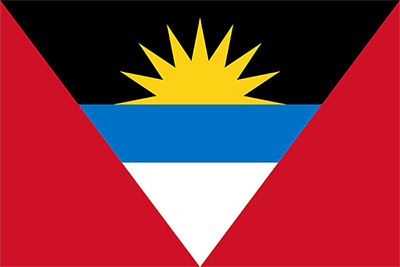
Antigua and Barbuda Flag— code
-
Antigua and Barbuda Flag— code
DownloadsRequest a high-resolution image
- Browse the images above and tap the code beneath the one you want — it copies to your clipboard.
- In the form below, enter your email and paste the code along with a short note telling us what you need.
- We'll email you the requested image, usually within a few business days.
Frequently asked questions
What does the flag of Antigua and Barbuda look like?
It is a red flag with an inverted isosceles triangle spanning the top edge and pointing to the bottom. Inside the triangle are three horizontal bands — black, blue at half width, and white — with a golden seven-point sun rising on the black band. The red field reads as two side triangles forming a V. The ratio is 2:3.
When was the Antigua and Barbuda flag adopted?
On February 27, 1967, the day Antigua became a state in free association with the United Kingdom — 11 days after royal assent to the West Indies Act 1967. At full independence on November 1, 1981, the flag was retained unchanged.
Who designed the Antigua and Barbuda flag?
Sir Reginald Samuel, an Antiguan art teacher, artist, and sculptor. His design won a 1966–67 public competition that drew more than 600 entries, taking a first prize of $500 — reportedly as one of the last entries admitted. He was knighted in 2006.
What do the colors of the Antigua and Barbuda flag mean?
Red stands for the energy and dynamism of the people; black for the soil and the African ancestry of the people; blue for hope and the surrounding Caribbean Sea; and white for the beaches. Read downward from the sun, the gold, blue, and white together stand for the sun, sea, and sand.
What does the sun on the Antigua and Barbuda flag mean?
The rising golden sun symbolizes the dawning of a new era. Since 1994 it has been rendered with seven full points; it has been suggested the seven stand for the six parishes plus Barbuda, though the designer himself did not have that in mind.
What does the V shape on the Antigua and Barbuda flag mean?
Victory. The two red triangles at the sides of the inverted central triangle form a V — in the words used at its adoption, "victory at last."
What are the official proportions and colors of the Antigua and Barbuda flag?
The ratio is 2:3, with the blue band at half the width of the black and white. No official national color or construction specification is published; the Pantone values in citable circulation — from the Beijing 2008 Flag Manual — are red 032, gold 109, blue 300, and black. The sun is specified as golden rather than plain yellow.
Why didn't Antigua and Barbuda change its flag at independence?
The 1967 flag was already the islands' own — chosen by public competition, distinctive, and easily recognized. When full independence came on November 1, 1981, the state simply kept it.
What flag did Antigua and Barbuda use before 1967?
British ensigns. As part of the Leeward Islands it flew the Blue Ensign with a badge of pineapples honoring the first governor, Sir Benjamin Pine; from the late 1950s a Blue Ensign carried Antigua's own arms — a shore landscape with an aloe plant and a sugar mill.

We Value Your Opinion Comments