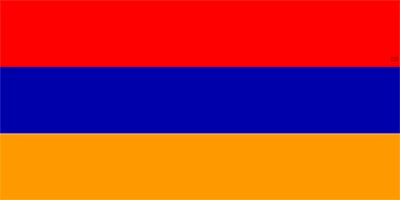

| Name | Hayastani drosh (Հայաստանի դրոշ — the Yeraguyn, "tricolor") |
|---|---|
| Adopted | August 1, 1918 (First Republic) August 24, 1990 (restored) June 15, 2006 (current law) |
| Proportion | 2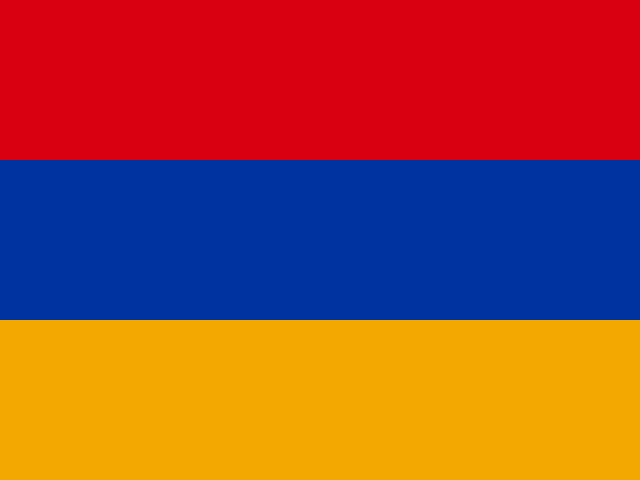 1 1 |
| Status | Meanings fixed by law (Law No. 149, Article 2) |
| Flag Day | June 15 (the 2006 law's anniversary; since 2010) |
| The Armenian flag is the Yeraguyn — red, blue, and orange in equal thirds at 1:2: the First Republic's banner of 1918, restored in 1990 and given its official meanings by the 2006 law. | |
| |
An overview
The national flag of Armenia — the Yeraguyn, the tricolor — is three equal horizontal bands of red, blue, and orange in a 1:2 ratio. It carries no emblem, and the law permits flags of any size that keep the proportion.
The design was proposed to the First Republic’s assembly on August 1, 1918, flew until the Soviet conquest of 1921, and spent nearly seventy years banned before returning over Yerevan in 1988. The Supreme Soviet restored it as the state flag on August 24, 1990 — the day after declaring sovereignty — and the Law on the National Flag of June 15, 2006, gave the modern flag its full legal frame: the official meanings of the colors, the display rules, and the buildings where it always flies.
The colors are standardized to the decimal: the Armenian National Institute of Standards fixed the exact shades — Pantone, hex, RGB, and CMYK — in 2012.
Red, blue, and orange
The combination is traditionally traced to the royal banners of the Rubenid dynasty of the Armenian Kingdom of Cilicia — red, blue, and yellow — with orange taking yellow’s place in 1918. By the account on record, Stepan Malkhasyants proposed the colors to the assembly without assigning them meanings; the members supplied readings of their own, and the state finally fixed the official ones 88 years later, in the 2006 law.
The orange had one early stumble: the cloth was so hard to source that in September 1918 the interior minister, Aram Manukian, instructed government institutions to use yellow until orange could be had. The parliament reaffirmed the tricolor in June 1919.
Design and official specification
The 2006 law sets the flag at 1:2 — three equal horizontal stripes of red, blue, and orange from the top — and expressly allows smaller and larger flags in the same proportion. The construction and colors were standardized by SARM in 2012. The First Republic’s flag had flown at 2:3; the modern 1:2 dates from the 1990 restoration.
| Element | Specification | Reference |
|---|---|---|
| Hoist (height) | 1.0 | 100 cm (39.4 in) |
| Fly (length) | 2.0 | 200 cm (78.7 in) |
| Ratio | 1 : 2 | Law No. 149, 2006 |
| Bands | Three equal horizontal — red, blue, orange from the top | Each 33.3 cm (13.1 in) on the reference flag |
| Sizes | Any size keeping the 1:2 proportion | Permitted by the law itself |
| Construction | Standardized by SARM | 2012 specifications |
| First Republic | The 1918 flag flew at 2 : 3 | The modern ratio dates from 1990 |
Official color specification
Armenia’s colors are fixed by a national standard: the 2012 specifications of SARM, the Armenian National Institute of Standards, define the three shades across print and screen — one of the few flags whose CMYK values are official.
| Color | HEX | RGB | Pantone |
|---|---|---|---|
| Red | #D90012 | 217, 0, 18 | 485 |
| Blue | #0033A0 | 0, 51, 160 | 286 |
| Orange | #F2A800 | 242, 168, 0 | 1235 |
Symbolism and meaning
Armenia’s meanings are law: Article 2 of the 2006 Law on the National Flag assigns each color its significance.
The man who proposed the colors gave them no meanings at all — the readings grew with the flag, and the law made them official in 2006.
How the flag evolved
The tricolor’s story runs from a funeral in Paris to a republic of two and a half years, through seven decades of prohibition, and back — the same three colors carried across more than a century.
-
1885
Alishan's designs

With no state of their own, Armenians had no flag — until the Armenian Students Association of Paris asked Father Ghevont Alishan for one to carry at Victor Hugo's funeral. His first design stacked red and green for the Easter Sundays of those names, with white to complete it; a second used red, green, and blue — the rainbow Noah saw from Ararat.
-
1918
The First Republic

On August 1, 1918, at the new republic's first assembly, the scholar Stepan Malkhasyants presented a now-lost report proposing red, blue, and orange — offering no meanings for the colors, which members traced to the royal banners of Cilicia. The flag was set at 2:3 and framed as temporary, pending a constituent assembly; it flew until the Red Army's conquest in 1921.
-
1952
The Soviet stripe

Under Soviet rule the tricolor was banned. The Armenian SSR's first flag of 1922 was a red banner with gold Armenian initials; from 1952 the republic flew red with a horizontal blue stripe through the middle, the hammer, sickle, and star in the canton.
-
1990
The Yeraguyn returns
In May 1988 the banned tricolor flew over Yerevan for the first time in over sixty years. On August 24, 1990 — the day after declaring sovereignty — the Supreme Soviet made it the state flag, now at 1:2; full independence followed on September 21, 1991, and the 2006 law fixed the flag's meanings, display rules, and standing in law.
Who designed the Armenian flag?
Stepan Malkhasyants — the philologist, lexicographer, and academician best known for his dictionary of the Armenian language. By the memoir of Simon Vratsian, later the republic’s prime minister, Malkhasyants presented a report on the flag at the assembly’s first session on August 1, 1918, proposing the horizontal red, blue, and orange; the report itself has not survived.
What the record preserves is the design’s modesty: proposed without meanings, set at 2:3, and framed as temporary until a constituent assembly could choose a permanent flag. That assembly never met — and the temporary tricolor became one of the region’s most enduring symbols.
Legal status and display rules
The Constitution establishes the tricolor among the state symbols — Article 13 of the 1995 text, Article 21 since the 2015 revision — and leaves the detail to law. The operative statute is Law No. 149 of June 15, 2006, successor to the restoration law of August 24, 1990. Under its Article 3 the flag is always displayed at the residence of the President, the National Assembly, the Government, the Constitutional Court and the courts, the Prosecutor’s Office, the Human Rights Defender, the Central Bank, and state and local government buildings, including Yerevan’s city hall.
The law’s etiquette is exact: the flag flies whole, clean, and unfaded, its lower edge at least 2.5 m (8.2 ft) off the ground. In mourning it is lowered to half-mast with a black ribbon fixed at the top — the ribbon as long as the flag itself. Flag Day is June 15, the law’s own anniversary, first celebrated in Yerevan in 2010; daily display is encouraged, and required on specified holidays.
Things you may not know
The flag once ran out of orange. The First Republic could not reliably source orange cloth — so in September 1918 the interior minister ordered institutions to fly red, blue, and yellow until the proper shade could be found.
It was adopted as temporary. The 1918 assembly framed the tricolor as a stopgap, at 2:3, pending a constituent assembly that would pick a permanent flag. The assembly never convened; the stopgap has now outlasted empires.
The anthem sews it. Armenia’s national anthem, Mer Hayrenik, devotes two verses to the flag — a sister describing the tricolor she stitched through sleepless nights as a treasured symbol for the nation.
-

Armenia Flag— code
-

Armenia Flag— code
DownloadsRequest a high-resolution image
- Browse the images above and tap the code beneath the one you want — it copies to your clipboard.
- In the form below, enter your email and paste the code along with a short note telling us what you need.
- We'll email you the requested image, usually within a few business days.
Frequently asked questions
What does the flag of Armenia look like?
The flag of Armenia — the Yeraguyn, or tricolor — is three equal horizontal bands of red, blue, and orange, from top to bottom, in a 1:2 ratio. It carries no emblem; the law permits flags of any size that keep the proportion.
When was the Armenian flag adopted?
The red-blue-orange tricolor was sanctioned by the First Republic of Armenia on August 1, 1918, and flew until 1921. The Supreme Soviet restored it on August 24, 1990, the day after declaring sovereignty, and the current legal framework is the Law on the National Flag of June 15, 2006.
Who designed the Armenian flag?
The scholar Stepan Malkhasyants proposed the red, blue, and orange combination to the First Republic's assembly on August 1, 1918, in a report that has not survived. By the account on record he offered no meanings for the colors — assembly members traced them to the royal banners of the Cilician kingdom.
What do the colors of the Armenian flag mean?
The meanings are official — Article 2 of the 2006 Law on the National Flag sets them: red for the Armenian Highland and the people's continued struggle for survival, the Christian faith, and Armenia's independence and freedom; blue for the will of Armenians to live beneath peaceful skies; orange for the creative talent and hard-working nature of the people.
Why does the Armenian flag have orange?
The combination is traditionally traced to the royal colors of the Rubenid dynasty of the Armenian Kingdom of Cilicia — red, blue, and yellow — with orange taking yellow's place in 1918. Orange proved hard to source: in September 1918 the interior minister, Aram Manukian, instructed institutions to use yellow until orange cloth could be had.
What are the official proportions of the Armenian flag?
The ratio is 1:2 — the length is twice the height — with three equal bands. The law itself allows flags of any size that keep the proportion. The First Republic's original flag of 1918 was 2:3; the modern 1:2 dates from the 1990 restoration.
What are the official colors of the Armenian flag?
The Armenian National Institute of Standards (SARM) fixed them in 2012: red Pantone 485 (#D90012), blue Pantone 286 (#0033A0), and orange Pantone 1235 (#F2A800), with official CMYK values for each — one of the few flags whose CMYK is defined by a national standard.
What flag did Soviet Armenia use?
The tricolor was banned under Soviet rule. The Armenian SSR first flew a red banner with gold Armenian initials from 1922; from 1952 its flag was red with a horizontal blue stripe through the middle and the hammer, sickle, and star — the design the tricolor replaced on August 24, 1990.
When is Armenia's Flag Day?
June 15 — the anniversary of the 2006 Law on the National Flag — first celebrated in Yerevan on June 15, 2010. Daily display of the flag is encouraged; the law requires it on specified holidays, and government buildings from the presidential residence to the Central Bank fly it at all times.

We Value Your Opinion Comments