| Name | Flagge Österreichs (rot-weiß-rot) |
|---|---|
| Adopted | 1230 (first recorded) October 31, 1918 (the republic) May 1, 1945 (restored) |
| Origin | The Babenberg Bindenschild (legend credits Leopold V) |
| Proportion | 3 2 2 |
| Status | Colors in the constitution (Article 8a, since 1981) |
| Variants | Civil flag plain; the state flag adds the federal eagle (Wappengesetz, 1984) |
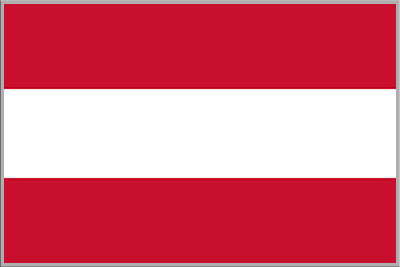
| The Austrian flag is red-white-red in equal thirds at 2:3 — the Babenberg Bindenschild recorded in 1230, the republic's flag since 1918, restored in 1945, its colors written into the constitution. | |
| |
An overview
The national flag of Austria is a horizontal triband of red, white, and red — three equal bands in a 2:3 ratio. It comes in two legal forms: the plain civil flag anyone may fly, and the state flag, which centers the black federal eagle on the white band and is reserved to the authorities named by law.
The design is considered one of the oldest national flag designs still in use. Its red-white-red arms — the Bindenschild — are documented on a ducal seal of 1230, and from early on the colors stood for the country itself rather than for the dynasty that ruled it. The modern republic adopted them on October 31, 1918; the flag vanished under the 1938–45 annexation and was restored on May 1, 1945.
Today the colors sit in the constitution itself — Article 8a of the Federal Constitutional Law — while the Wappengesetz of 1984 governs the eagle-bearing state flag.
The Bindenschild
The legend is one of vexillology’s best: at the Siege of Acre in 1191, Duke Leopold V fought until his white surcoat was soaked entirely in blood — and when he removed his belt, the band beneath was still white. Struck by the sight, he took red-white-red as his banner.
Historians discredit the tale. The earliest record of the arms is the seal of Duke Frederick II, the last Babenberg, in 1230, and the design’s true origin — possibly inherited through Styrian and Carinthian houses — was never conclusively established. What the record does show is the design’s durability: through empires that flew black and gold, the red-white-red remained the mark of Austria itself.
Design and official specification
The specification is constitutional in the most literal sense: Article 8a of the Federal Constitutional Law fixes the colors as red-white-red and the flag as three equally wide horizontal bands, the middle one white. The Wappengesetz of 1984 adds the state flag — the same triband with the federal arms at its center, in the same 2:3 proportions.
| Element | Specification | Reference |
|---|---|---|
| Hoist (height) | 1.0 | 100 cm (39.4 in) |
| Fly (length) | 1.5 | 150 cm (59.1 in) |
| Ratio | 2 : 3 | Height to length |
| Bands | Three equal horizontal — red, white, red | Each 33.3 cm (13.1 in) on the reference flag |
| Legal anchor | Article 8a of the Federal Constitutional Law | BGBl. 350/1981 — the colors and arms sit in the constitution |
| State flag | The national flag with the federal arms centered | Wappengesetz, 1984; for authorities the law names |
| Shade | Pantone 186 C — the only legally fixed shade, for military use | Defence Ministry regulation, May 14, 2018 |
Official color specification
Austrian law prescribes the colors, not the shades — with one exception. For military use, a Defence Ministry regulation of May 14, 2018, fixes the red at Pantone 186 C, replacing the Pantone 032 C that a directive had specified since January 31, 2000. The deeper 186 C is the shade flown today.
| Color | HEX | RGB | Pantone |
|---|---|---|---|
| Red | #C8102E | 200, 16, 46 | 186 C |
| White | #FFFFFF | 255, 255, 255 | — |
Symbolism and meaning
The triband carries no official meanings — it is heraldry, not allegory. The documented symbolism all belongs to the eagle of the state flag.
The eagle’s symbolism is statutory — written into the arms law of May 8, 1919, and the chain added after 1945; the bands’ meanings are tradition.
How the flag evolved
Eight centuries in four moves: a medieval shield, a republic’s choice, a restoration with one added symbol, and a shade fixed by decree.
-
1230
The Bindenschild

The red shield with its white band — the Bindenschild — enters the record on the 1230 seal of Duke Frederick II, the last Babenberg. Legend backdates it to Leopold V at the Siege of Acre in 1191, his white surcoat blood-soaked except beneath the belt; historians discredit the tale, and the design's true origin was never conclusively established. What set it apart early: it stood for the country, not the ruling house.
-
1918
The republic's colors

The empires that had flown black and gold ended — the Holy Roman in 1806, Austria-Hungary in 1918 — and on October 31, 1918, the new state's Council adopted red-white-red as the national colors. On May 8, 1919, the arms law added the single-headed black eagle: a golden hammer for the workers, a sickle for the farmers, a mural crown for the middle class.
-
1945
Restored, with broken chains

Seven years of annexation by Nazi Germany erased the flag; it returned on May 1, 1945, with the First Republic's eagle restored — and one addition. A broken iron chain now hangs from the eagle's legs, marking the restoration of Austria's independence.
-
2018
The shade, by decree
General law names the colors, not the shades — so the exact red is a military matter. A directive of January 31, 2000, set Pantone 032 C; the Defence Ministry's regulation of May 14, 2018, replaced it with the deeper 186 C, the shade flown today.
Who designed the Austrian flag?
No one on record. Legend credits Duke Leopold V and a battle-stained surcoat; the record credits no one, beginning simply with the arms on Frederick II’s seal of 1230. Whoever first barred white across red, the design predates the idea of a national flag itself — and outlasted every banner devised since.
The eagle that joins it on the state flag is younger and better documented: adopted by the republic’s arms law on May 8, 1919, restored in 1945 with the broken chain added to its legs.
Legal status and display rules
The flag’s legal home is unusually high: Article 8a of the Federal Constitutional Law — added in 1981 — places the colors and the federal arms in the constitution itself. The operative statute beneath it is the Wappengesetz of March 28, 1984, which defines the federal service flag (the triband bearing the arms) and names the persons and authorities entitled to carry it on public occasions.
Everyone else flies the plain red-white-red freely. Private persons may even use depictions of the state symbols, provided they claim no official authorization — and the law makes misuse and defilement of the symbols punishable. The colors themselves the republic fixed at its birth: adopted by the State Council on October 31, 1918, twelve days before the republic was proclaimed.
Things you may not know
The legend is medieval branding. The blood-soaked-surcoat story of 1191 has been retold for centuries — and discredited by historians. The arms simply appear, already formed, on a duke’s seal in 1230.
Austria’s eagle carried a hammer and sickle before the Soviet Union existed. The republic’s arms law of May 8, 1919, gave the eagle its golden hammer, sickle, and mural crown — for workers, farmers, and the middle class — three years before the USSR was founded.
The red changed by decree in 2018. General law names the colors without shades, so the exact red is a military regulation: Pantone 032 C from 2000, replaced by the deeper 186 C on May 14, 2018.
-
Austria Flag— code
-

Austria Flag— code
DownloadsRequest a high-resolution image
- Browse the images above and tap the code beneath the one you want — it copies to your clipboard.
- In the form below, enter your email and paste the code along with a short note telling us what you need.
- We'll email you the requested image, usually within a few business days.
Frequently asked questions
What does the flag of Austria look like?
It is a horizontal triband of red, white, and red — three equal bands in a 2:3 ratio, with no emblem on the civil flag. The state flag, flown by federal authorities, carries the black federal eagle at the center of the white band.
Is the Austrian flag the oldest in the world?
It is considered one of the oldest national flag designs still in use: the red-white-red arms are documented on the seal of Duke Frederick II in 1230, and the design was associated with the country itself — not a ruling dynasty — from early on. Denmark makes a comparable claim for its Dannebrog, whose legend dates to 1219.
What is the legend behind the Austrian flag?
That Duke Leopold V fought the 1191 Siege of Acre until his white surcoat was soaked in blood — and when he removed his belt, the band beneath was still white, giving him red-white-red. Modern historians discredit the story; the earliest record of the arms is the 1230 seal, and the design's true origin was never conclusively established.
What do the colors of the Austrian flag mean?
No official meanings are on record — the red-white-red is heraldic, inherited from the Babenberg arms rather than assigned a symbolism. The white band is sometimes said to stand for the Danube, but that reading is traditional, not established.
What is the difference between the Austrian civil flag and state flag?
The civil flag is the plain red-white-red triband, free for anyone to fly. The state flag — the Bundesdienstflagge — adds the federal coat of arms at the center and is reserved by the Wappengesetz of 1984 to the authorities it names; private persons may use depictions of the symbols so long as they claim no official authorization.
What does the eagle on the Austrian state flag mean?
The single-headed black eagle, adopted by the republic's arms law of May 8, 1919, carries class symbolism: a golden hammer for the workers, a sickle for the farmers, and a mural crown for the middle class. The broken iron chain on its legs was added after 1945 to mark the restoration of Austria's independence.
What are the official colors of the Austrian flag?
The constitution fixes the colors — red-white-red, per Article 8a — but general law prescribes no exact shade. The only legally fixed value is military: a Defence Ministry regulation of May 14, 2018, specifies Pantone 186 C (#C8102E), replacing the Pantone 032 C set by a directive in 2000.
When was the Austrian flag adopted?
The republic's State Council adopted red-white-red as the national colors on October 31, 1918, after the fall of Austria-Hungary; the arms law of May 8, 1919, added the eagle. Banned during the 1938–45 annexation, the flag was formally restored on May 1, 1945.
What are the proportions of the Austrian flag?
The ratio is 2:3 — height to length — with three equal horizontal bands, the middle one white. The state flag with the eagle uses the same 2:3 proportions under the Wappengesetz of 1984.

We Value Your Opinion Comments