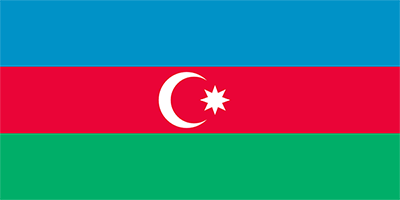

| Name | Azərbaycan bayrağı (Üçrəngli Bayraq — the Tricolor) |
|---|---|
| Adopted | November 9, 1918 (first republic) February 5, 1991 (restored) October 22, 2013 (colors standardized) |
| Proportion | 2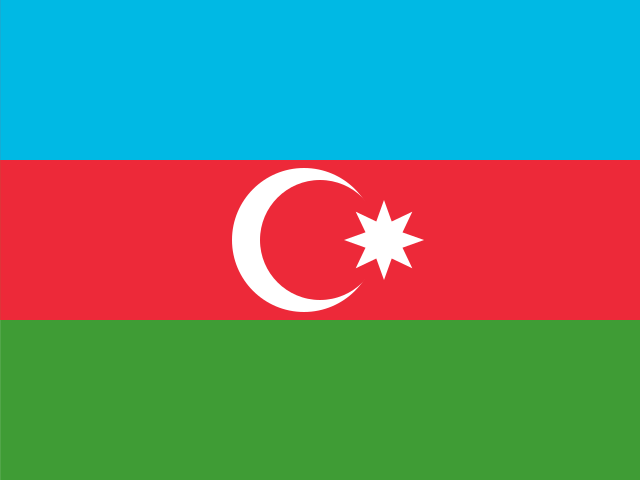 1 1 |
| Emblem | White crescent + eight-pointed star (centered on the red band, both faces) |
| Flag Day | November 9 (Law No. 595, 2009; a non-working day) |
| The Azerbaijani flag is the Tricolor — Turkic blue, the red of progress, the green of Islam under a white crescent and eight-point star: the first republic's banner of 1918, restored in 1991. | |
| |
An overview
The national flag of Azerbaijan — the Üçrəngli Bayraq, the Tricolor — is three equal horizontal bands of bright blue, red, and green in a 1:2 ratio, with a white crescent and an eight-pointed star centered on the red band, on both faces. The description and ratio sit in the constitution itself, in Article 23.II.
The design belongs to the first republic: adopted on November 9, 1918, by the Azerbaijan Democratic Republic, banned after the Soviet invasion of 1920, revived in the independence demonstrations of the late 1980s, and restored to law on February 5, 1991 — by which time Nakhchivan had already flown it for three months. On land it serves as the civil, state, and war flag; at sea, as ensign and naval jack.
Its three colors carry a program: the blue of Turkic heritage, the red of progress, and the green of Islam — one band for each word of Ali bay Huseynzade’s call to "Turkify, Islamicize, Europeanize."
The crescent and the eight-point star
The white crescent and star carried over from the republic’s first flag of June 1918, an Ottoman-inspired red banner that lasted less than five months. The star kept a distinction of its own: eight points, not five.
Two explanations are on record. Fatali Khan Khoyski, the first republic’s head of government, pointed to the eight letters of "Azerbaijan" as written in the Arabic script. Tradition reads the points instead as the Turkic peoples of the old classification — Azerbaijanis, Ottomans, Chagatais, Tatars, Kipchaks, Seljuks, and Turkomans, the Kipchaks possibly standing for two peoples to complete the eight.
Design and official specification
The constitution fixes the form — three equal bands, the crescent and star, the 1:2 ratio — and the flag laws fix the practice, down to the rule that a vertically hung flag rotates so the green band hangs to the left. The exact shades have their own statute: standardized to Pantone on October 22, 2013, and ratified in 2018.
| Element | Specification | Reference |
|---|---|---|
| Hoist (height) | 1.0 | 100 cm (39.4 in) |
| Fly (length) | 2.0 | 200 cm (78.7 in) |
| Ratio | 1 : 2 | Constitution, Article 23.II |
| Bands | Three equal horizontal — blue, red, green from the top | Each 33.3 cm (13.1 in) on the reference flag |
| Emblem | A white crescent and eight-pointed star, centered on the red band | On both the front and the back |
| Vertical display | Rotated so the green band is on the left | Per the flag rules |
| Colors | Standardized October 22, 2013 | Pantone 306 C / Red 032 C / 362 C; ratified 2018 |
Official color specification
Azerbaijan’s shades are set by standard: the October 22, 2013 specification — ratified in 2018 — names the Pantone for each band, with RAL and CMYK values fixed alongside. The restored flag of 1991 had flown for two decades under the 2004 decree’s slightly different values.
| Color | HEX | RGB | Pantone |
|---|---|---|---|
| Blue | #00B5E2 | 0, 181, 226 | 306 C |
| Red | #EF3340 | 239, 51, 64 | Red 032 C |
| Green | #509E2F | 80, 158, 47 | 362 C |
| White (crescent + star) | #FFFFFF | 255, 255, 255 | — |
Symbolism and meaning
The tricolor reads as a sentence — three ideas from the nationalist thinker Ali bay Huseynzade, one per band.
The crescent and eight-point star add the older layer — Khoyski’s eight letters, or the eight Turkic peoples, depending on whose account you read.
How the flag evolved
A party banner, a republic’s flag, a banned symbol sewn in exile and smuggled home, and a restoration that began in Nakhchivan — the tricolor’s century, in four moves.
-
1918
Two flags in one year

The Azerbaijan Democratic Republic declared independence on May 28, 1918, and reached for symbols at once: its first state flag, adopted June 21, was a red banner with a white crescent and eight-pointed star, after the Ottoman model. On November 9, 1918, the government replaced it with the tricolor — the blue, red, and green of Ali bay Huseynzade's call to "Turkify, Islamicize, Europeanize," flown by the Musavat Party since 1917. It lasted until the Soviet invasion of April 1920.
-
1920
The Soviet decades

Under Soviet rule the tricolor was banned; the republic's final Soviet flag ran red over a blue band along the bottom, the hammer, sickle, and star in the canton. The banned flag lived on anyway: in 1952 the exiled ADR founder Mammad Amin Rasulzade sewed a copy in Turkey, a friend smuggled it into Azerbaijan and hung it on his house in Maştağa in 1976, and in 1956 the protester Jahid Hilaloghlu raised the tricolor over Baku's Maiden Tower.
-
1990
Nakhchivan first
The tricolor returned to the streets in the late-1980s independence demonstrations — and returned to law from the edge inward: on November 17, 1990, the Nakhchivan Autonomous Republic's assembly adopted the 1918 flag at its first session, and Baku followed on February 5, 1991, with slight changes to the colors and size. Independence came later that year.
-
2013
The colors, standardized

The restored flag flew for two decades under the 2004 decree's color values. On October 22, 2013, the shades were standardized to Pantone — 306 C blue, Red 032 C, 362 C green, with RAL and CMYK fixed alongside — and the standard was ratified in 2018. The subtly different pre-2013 shades became a chapter of their own.
Who designed the Azerbaijani flag?
No single designer is on record. The color program is Ali bay Huseynzade’s — his "Turkify, Islamicize, Europeanize" gave the bands their meanings, and his followers in the Musavat Party flew the tricolor from 1917. The government of the Azerbaijan Democratic Republic made it the state flag on November 9, 1918, carrying over the white crescent and eight-point star from the republic’s first, short-lived flag.
The flag’s most famous words belong to the republic’s founder, Mammad Amin Rasulzade: the flag once raised, he declared, will never fall — the rallying cry of Azerbaijani independence, and the promise the 1991 restoration kept.
Legal status and display rules
The flag’s description and ratio sit in Article 23.II of the constitution, and Law No. 683 of June 8, 2004, governs its use and display. The flag holds official status in the Nakhchivan Autonomous Republic as well — fittingly, since Nakhchivan’s assembly restored it on November 17, 1990, three months before the rest of the country. Desecration is a crime: Article 324 of the Criminal Code punishes destruction, damage, or contemptuous markings with up to two years’ restriction of liberty or a year’s imprisonment.
State Flag Day is November 9 — the 1918 adoption date — a non-working holiday established by Law No. 595 of November 17, 2009; President Ilham Aliyev said the signing date itself honored Nakhchivan’s 1990 restoration. The National Flag Square in Baku opened on September 1, 2010, its 162 m (531 ft) pole flying a 70 × 35 m (230 × 115 ft), 350 kg (772 lb) flag — the world’s tallest unsupported flagpole until Dushanbe’s in 2011; the pole was dismantled in 2017.
Things you may not know
Nakhchivan restored it first. The autonomous republic’s assembly adopted the 1918 flag on November 17, 1990 — three months before Baku — and Flag Day’s founding law was deliberately signed on a November 17 in its honor.
A banned flag was smuggled home. The exiled founder Mammad Amin Rasulzade sewed a copy of the tricolor in Turkey in 1952; a friend carried it secretly into Soviet Azerbaijan and hung it on his house in Maştağa in 1976. It has hung in the National Museum of History since 2003.
The flag had the world’s tallest flagpole. Baku’s National Flag Square raised a 350 kg (772 lb) flag on a 162 m (531 ft) pole in 2010 — the tallest unsupported flagpole on Earth until Dushanbe’s overtook it in 2011.
-

Azerbaijan Flag— code
-
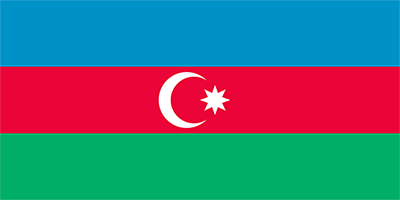
Azerbaijan Flag— code
DownloadsRequest a high-resolution image
- Browse the images above and tap the code beneath the one you want — it copies to your clipboard.
- In the form below, enter your email and paste the code along with a short note telling us what you need.
- We'll email you the requested image, usually within a few business days.
Frequently asked questions
What does the flag of Azerbaijan look like?
It is a horizontal tricolor of bright blue, red, and green in a 1:2 ratio, with a white crescent and an eight-pointed star centered on the red band — appearing on both faces of the flag. Azerbaijanis call it the Üçrəngli Bayraq, the Tricolor.
What do the colors of the Azerbaijani flag mean?
The blue stands for Azerbaijan's Turkic heritage, the red for progress and the building of a modern state, and the green for Islam. The program traces to the nationalist Ali bay Huseynzade's call to "Turkify, Islamicize, Europeanize," whose three ideas the three bands carry.
What does the eight-pointed star on the flag mean?
Two readings are on record. Fatali Khan Khoyski, the first republic's head of government, pointed to the eight letters of "Azerbaijan" written in the Arabic script. Tradition also reads the points as the Turkic peoples of the pre-Soviet classification — Azerbaijanis, Ottomans, Chagatais, Tatars, Kipchaks, Seljuks, and Turkomans, with the Kipchaks possibly counting as two.
When was the Azerbaijani flag adopted?
The Azerbaijan Democratic Republic adopted the tricolor on November 9, 1918, replacing its first, Ottoman-inspired flag of June that year. Banned after the 1920 Soviet invasion, it was restored by the Nakhchivan Autonomous Republic on November 17, 1990, and by Azerbaijan itself on February 5, 1991. The colors were standardized on October 22, 2013.
Who designed the Azerbaijani flag?
No single designer is on record. The tricolor the ADR government adopted in November 1918 had flown for the Musavat Party since 1917, and its color program belongs to Ali bay Huseynzade's "Turkify, Islamicize, Europeanize." The crescent and eight-pointed star carried over from the republic's first flag.
What are the official colors of the Azerbaijani flag?
Since October 22, 2013 — ratified in 2018 — the standard fixes Pantone 306 C for the blue (#00B5E2), Pantone Red 032 C for the red (#EF3340), and Pantone 362 C for the green (#509E2F), with RAL and CMYK values alongside. From 1991 to 2013 the flag flew under the 2004 decree's slightly different values.
What flag did Soviet Azerbaijan use?
The tricolor was banned throughout Soviet rule. The Azerbaijan SSR's final flag was red over a blue band along the bottom, with the gold hammer and sickle and a red star in the canton, in the same 1:2 ratio the tricolor uses today.
When is Azerbaijan's Flag Day?
November 9 — State Flag Day, a non-working public holiday marking the 1918 adoption. It was established by Law No. 595, which President Ilham Aliyev signed on November 17, 2009 — a date he said was chosen deliberately, honoring the day in 1990 when Nakhchivan restored the flag.
Is desecrating the Azerbaijani flag a crime?
Yes. Article 324 of the Criminal Code — desecration of the state flag or state emblem — carries restriction of liberty for up to two years or imprisonment for up to one year, covering destruction, damage, or contemptuous markings by anyone 16 or older.

We Value Your Opinion Comments