| Nicknames | The Stars and Stripes Old Glory The Star-Spangled Banner |
|---|---|
| Adopted | June 14, 1777 (13-star version) July 4, 1960 (50-star version) |
| Designers | Francis Hopkinson (1777, attributed) Robert G. Heft (50-star arrangement) |
| Proportion | 19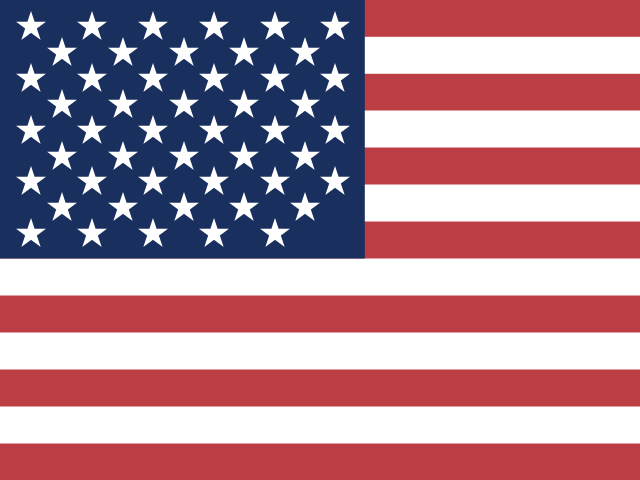 10 10 |
| Flag Day | June 14 |
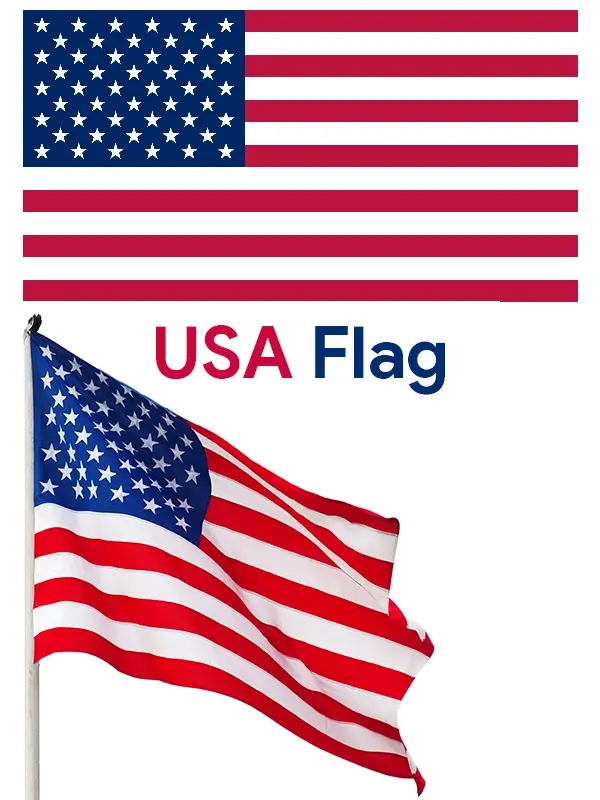
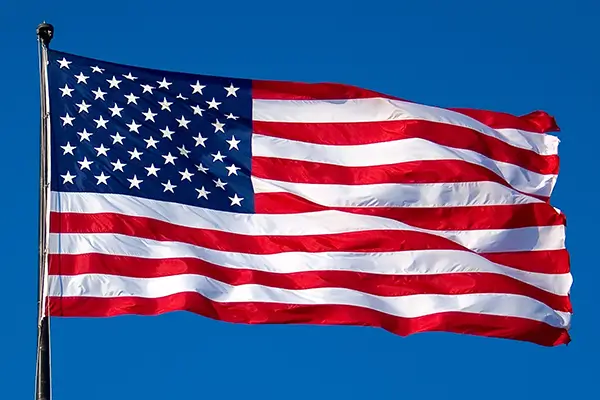
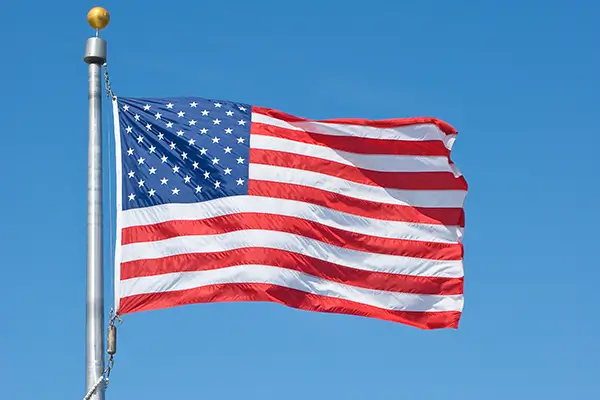
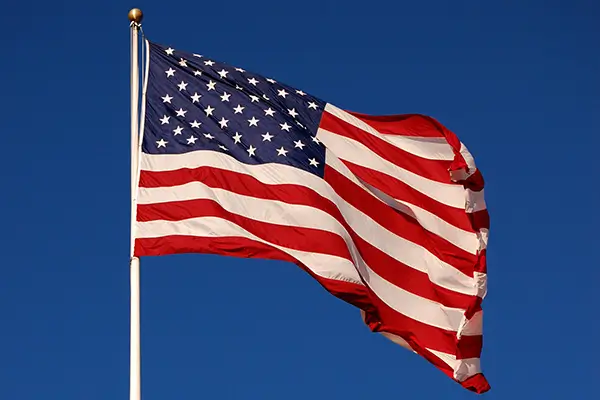
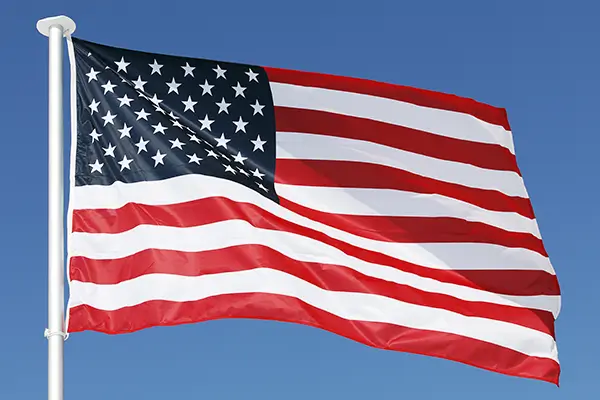
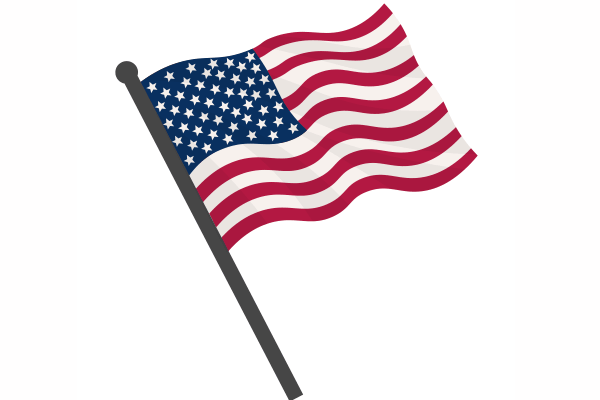
| The U.S. flag has 13 equal horizontal stripes — seven red and six white — with a blue canton (the “union”) in the upper hoist bearing 50 white five-pointed stars, one for each state. | |
| |
An overview
The flag of the United States — the Stars and Stripes — carries 13 horizontal stripes for the original colonies and 50 stars for the states. First adopted by the Continental Congress on June 14, 1777, it has been revised 26 times as the country grew, reaching its present 50-star form on July 4, 1960. The version flying today — the 27th — has remained unchanged since 1960, making it the longest-serving flag in the nation’s history.
The 13 equal stripes alternate red and white, beginning and ending with red, while a blue canton in the upper hoist — the union — holds 50 small white stars in nine offset rows. The flag’s proportions and star arrangement are set by Executive Order 10834, signed by President Eisenhower in 1959; its display is guided by the U.S. Flag Code.
Long after independence, the design stayed loose: for decades flag makers arranged the stars however they pleased, and only in 1912 was a single official pattern fixed.
The union — 50 stars
The blue rectangle in the upper hoist is the union (or canton). It carries 50 white five-pointed stars, one for each state, arranged in nine horizontal rows that alternate six and five stars across — five rows of six and four rows of five.
The 1777 resolution called for the stars to form “a new constellation,” but left their arrangement open, so early flags showed circles, rows, and even a single great star. A uniform layout was not fixed until 1912, and the current nine-row pattern arrived with the fiftieth star in 1960.
Design and official specification
The flag’s exact geometry is set by the attachment to Executive Order 10834 (1959). The hoist-to-fly ratio is 10 : 19; each of the 13 stripes is one-thirteenth of the hoist; the union is seven stripes tall and two-fifths of the fly wide; and each star is four-fifths as wide as a stripe. (Many flags sold for everyday use, such as 3 × 5 ft, only approximate this ratio.)
| Element | Proportion (hoist = 1) | On a 10 × 19 in flag |
|---|---|---|
| Hoist (height), A | 1.0000 | 10.00 in |
| Fly (width), B | 1.9000 | 19.00 in |
| Union / canton height, C | 0.5385 (7/13 of hoist) | 5.39 in |
| Union / canton width, D | 0.7600 (2/5 of fly) | 7.60 in |
| Star-field offset, E = F | 0.0538 (C / 10) | 0.54 in |
| Star spacing, G = H | 0.0633 (D / 12) | 0.63 in |
| Star diameter, K | 0.0616 (4/5 of a stripe) | 0.62 in |
| Stripe width, L | 0.0769 (1/13 of hoist) | 0.77 in |
Official color specification
The colors are the textile “cable” shades of Federal Specification DDD-F-416 — Old Glory Red, white, and Old Glory Blue. The law fixes the proportions and the count of stars and stripes, not a Pantone number, so the print and screen values below are the widely used approximations rather than the legal standard.
| Color | HEX | RGB | Pantone |
|---|---|---|---|
| Old Glory Red | #B22234 | 178, 34, 52 | 193 C |
| White | #FFFFFF | 255, 255, 255 | White |
| Old Glory Blue | #3C3B6E | 60, 59, 110 | 281 C |
Symbolism and meaning
The flag’s meaning is in its numbers: 50 stars for the 50 states and 13 stripes for the 13 colonies that broke with Britain in 1776. As states joined, stars were added; the stripes were locked at 13 in 1818 so the flag would always honor its origins.
The colors carry no official meaning in law. The reading repeated ever since comes from Charles Thomson, who explained the 1782 Great Seal to Congress: white for purity and innocence, red for hardiness and valor, and blue for vigilance, perseverance, and justice. Those meanings were written for the seal, but they are commonly applied to the flag. A 1977 booklet from the U.S. House of Representatives added a reading of the shapes: the star as “a symbol of the heavens,” the stripe as “the rays of light emanating from the sun.”
Color meanings from Charles Thomson’s 1782 report on the Great Seal; the star and stripe readings from a 1977 U.S. House of Representatives publication — neither is fixed in law.
How the flag evolved
The Stars and Stripes grew with the country — a new star for each new state. Its direct ancestor was the 1775 Continental Colors (the “Grand Union” flag), which kept Britain’s Union Jack in the canton; the first official Stars and Stripes followed in 1777. The timeline below traces all 27 official versions, from the original 13 stars to the 50 flown today.
The Flag Resolution, June 14, 1777: “Resolved, That the flag of the thirteen United States be thirteen stripes, alternate red and white; that the union be thirteen stars, white in a blue field, representing a new constellation.”
-
1777
13 stars
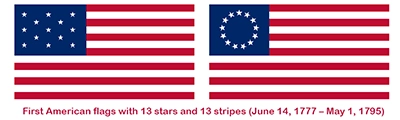
On June 14, 1777, Congress resolved that the flag be 13 stripes, alternate red and white, with 13 stars “white in a blue field, representing a new constellation.” No star arrangement was fixed, so circular and row patterns both appeared. June 14 is now Flag Day.
-
1795
15 stars
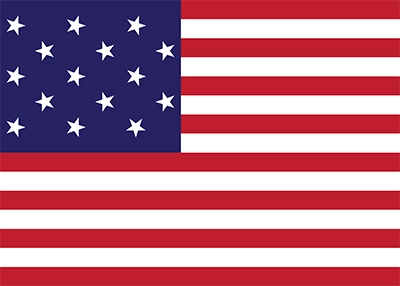
Vermont and Kentucky each brought a star — and a stripe. This was the only official U.S. flag with more than 13 stripes, and the very flag that flew over Fort McHenry in 1814, inspiring the national anthem.
-
1818
20 stars
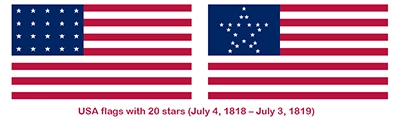
With five more states, the Flag Act of 1818 reset the stripes permanently to 13 for the original colonies and added one star per state — a new star to join each Fourth of July after admission.
-
1819
21 stars
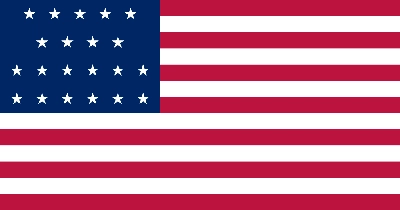
Illinois added the 21st star.
-
1820
23 stars
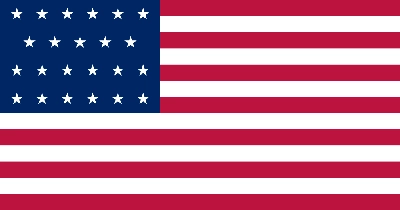
Alabama and Maine were admitted together, bringing the count to 23.
-
1822
24 stars
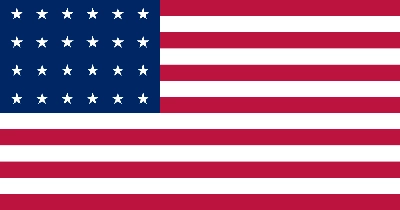
Missouri added the 24th star; this flag flew for 14 years.
-
1836
25 stars
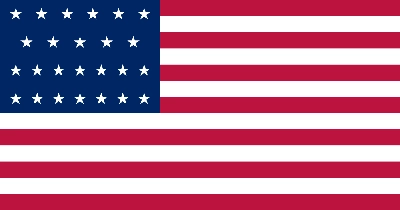
Arkansas brought the 25th star.
-
1837
26 stars
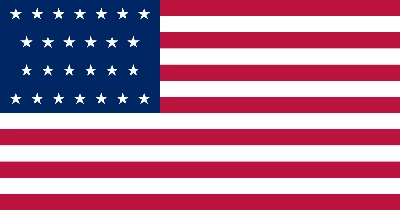
Michigan added the 26th star.
-
1845
27 stars
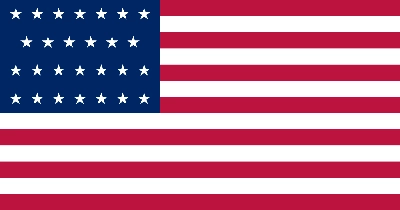
Florida joined the Union, adding the 27th star for a single year.
-
1846
28 stars
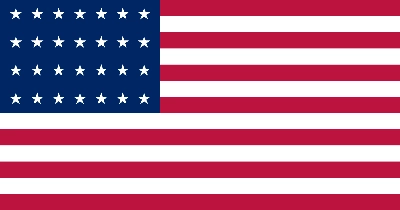
Texas brought the 28th star.
-
1847
29 stars
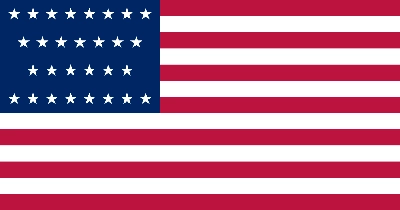
Iowa added the 29th star.
-
1848
30 stars
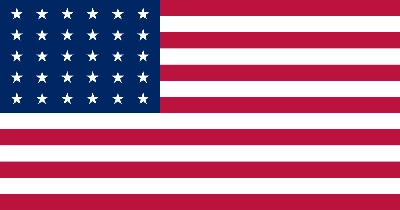
Wisconsin brought the 30th star.
-
1851
31 stars
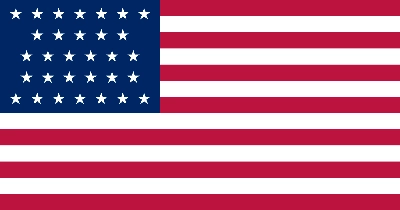
California added the 31st star; this flag served for seven years.
-
1858
32 stars
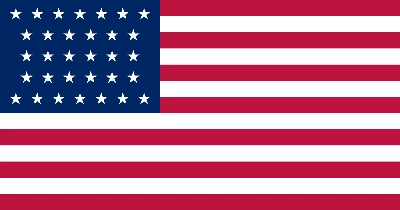
Minnesota brought the 32nd star.
-
1859
33 stars
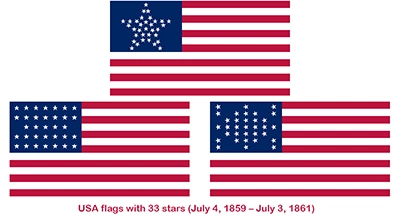
Oregon added the 33rd star.
-
1861
34 stars
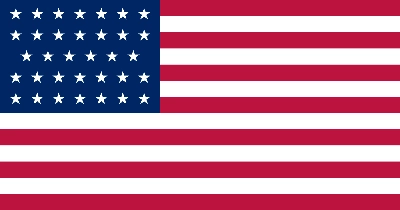
Kansas brought the 34th star, on the eve of the Civil War.
-
1863
35 stars
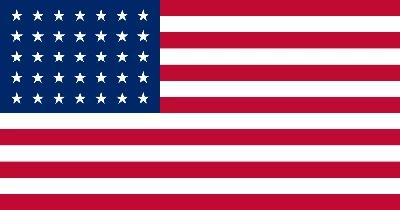
West Virginia, split from Virginia during the war, added the 35th star.
-
1865
36 stars
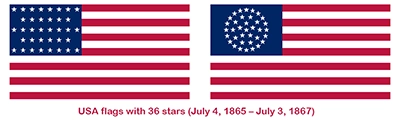
Nevada brought the 36th star.
-
1867
37 stars
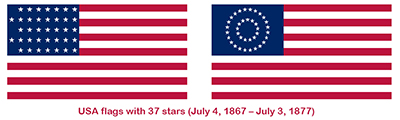
Nebraska added the 37th star; this flag flew for 10 years.
-
1877
38 stars
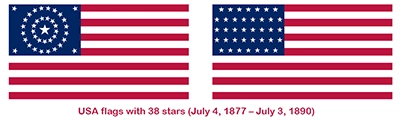
Colorado, the “Centennial State,” brought the 38th star.
-
1890
43 stars
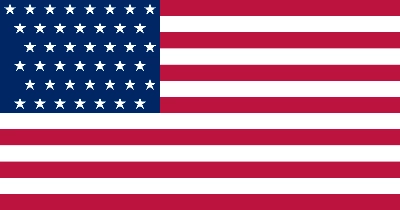
Five states admitted in 1889–90 — the Dakotas, Montana, Washington, and Idaho — jumped the count to 43; the 39- through 42-star flags were never official.
-
1891
44 stars
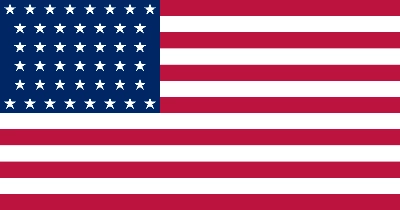
Wyoming added the 44th star.
-
1896
45 stars
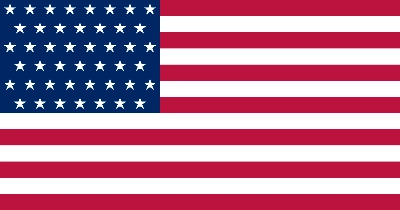
Utah brought the 45th star; this flag served 12 years.
-
1908
46 stars
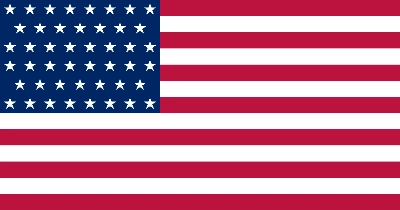
Oklahoma added the 46th star.
-
1912
48 stars
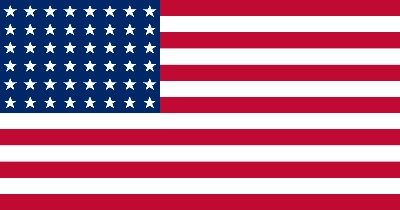
New Mexico and Arizona brought the count to 48. President Taft’s order finally fixed the star arrangement — six rows of eight — and this flag served 47 years, through both World Wars.
-
1959
49 stars
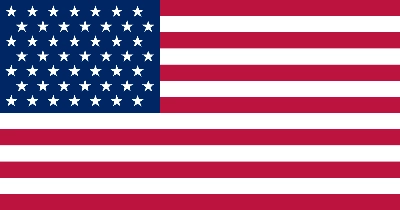
Alaska added the 49th star, set in seven rows of seven. It was the official flag for just one year.
-
1960
50 stars
Hawaii brought the 50th star. The current design — 50 stars in nine offset rows, from a layout the teenager Robert G. Heft submitted as a class project — became official on July 4, 1960. No official U.S. flag design has flown longer.
Who designed the American flag?
The famous Betsy Ross story — that she sewed the first flag for George Washington in 1776 — was first told in 1870, by her grandson, and no contemporary record supports it. The strongest documented claim belongs to Francis Hopkinson, a New Jersey delegate to the Continental Congress and a signer of the Declaration of Independence, who sought payment in 1780 for designing the U.S. flag. The current 50-star arrangement was designed in 1958 by Robert G. Heft, then a 17-year-old Ohio student.
Whoever stitched the first one, the new flag reached the field within months: it was carried into battle at the Battle of Brandywine on September 11, 1777, and first flew over foreign soil in early 1778 at Nassau, in the Bahamas, where American sailors took a British fort.
“Old Glory” and the Star-Spangled Banner
Two of the flag’s nicknames have stories of their own. “Old Glory” belonged first to a single flag: in 1824, the Salem sea captain William Driver, newly made master of the brig Charles Doggett, was given a 24-star flag by his mother and a circle of local women for his 21st birthday. Hoisting it, he is said to have named it “Old Glory.” It sailed the world with him; he carried it to Nashville when he left the sea in 1837, and during the Civil War he hid it sewn inside a quilt. When Union troops entered Nashville on February 25, 1862, he brought it out and raised it over the capitol. His Old Glory is now at the Smithsonian — and the name long ago spread to the flag itself.
“The Star-Spangled Banner” was also one flag: the 15-star, 15-stripe garrison flag sewn by Mary Pickersgill for Fort McHenry. Through the rainy British bombardment of Baltimore on September 13–14, 1814, the fort flew its smaller storm flag; on the morning of the 14th, as the British withdrew, the great garrison flag was raised in its place. Watching from a ship, where he had gone to negotiate a prisoner’s release, the lawyer Francis Scott Key saw it flying that morning and drafted a poem, “The Defence of Fort M’Henry.” Set to the tune of an English song, “To Anacreon in Heaven,” it was soon renamed “The Star-Spangled Banner” and, in 1931, made the national anthem; its four verses each close, “O’er the land of the free and the home of the brave.” That very flag survives at the Smithsonian’s National Museum of American History.
Flag Day, June 14
Flag Day marks June 14, 1777 — the date Congress adopted the first Stars and Stripes. The earliest known celebration was held in Hartford, Connecticut, in 1861, and the first national observance came on the resolution’s centennial, June 14, 1877. As the custom spread, President Woodrow Wilson called for a nationwide observance in 1916, and in 1949 Congress made June 14 a permanent National Flag Day, signed into law by President Truman.
The U.S. Flag Code and how to treat the flag
Display of the flag is guided by the U.S. Flag Code (Title 4 of the U.S. Code), first drawn up at a national conference in 1923 and made federal law in 1942. It is advisory: it sets out customs of respect but carries no penalties for private citizens.
Marks of respect
- Display it from sunrise to sunset; if flown at night, keep it well lit.
- When hung flat or in a window, place the union (the stars) at the observer’s upper left.
- Raise the flag briskly and lower it ceremonially; for mourning, hoist it to the peak first, then lower it to half-staff.
- Retire a worn flag with dignity — preferably by burning — in a respectful ceremony.
Never do this
- Let the flag touch the ground, the floor, or water.
- Use it as clothing, drapery, or bedding, or to cover a ceiling.
- Carry it flat or horizontally, or use it to hold or carry anything.
- Draw or print on it, or fasten anything to it that would mark or damage it.
Folding the flag
Folding the flag into a triangle is military custom rather than a rule of the Flag Code. Held waist-high and parallel to the ground, it is folded in half lengthwise twice — the blue union on the outside — then folded corner over corner in triangles, about 13 folds in all, until only the field of stars shows. No meaning is fixed for the individual folds, though many ceremonies pair them with a recited script.
Things you may not know
The current 50-star arrangement began as homework. In 1958, anticipating statehood for Alaska and Hawaii, 17-year-old Robert Heft stitched a 50-star flag for a class project; his design was one of many considered and the one President Eisenhower chose — and the B− on his assignment became an A.
The flag has been officially changed 26 times since the first Stars and Stripes of 1777 — almost always to add stars — for 27 versions in all. Yet the 50-star design has now flown for more than 65 years, longer than any before it.
Six American flags were planted on the Moon by the Apollo crews. And by law or presidential proclamation a handful of flags fly day and night, among them those over Fort McHenry, the Marine Corps War Memorial (the Iwo Jima statue), and Flag House Square in Baltimore.
-

USA Flag— code
-

USA Flag— code
-

USA Flag— code
-

USA Flag— code
-

USA Flag— code
-

USA Flag— code
-

USA Flag— code
-

USA Flag— code
-

USA Flag— code
-

USA Flag— code
-

USA Flag— code
-

USA Flag— code
-

USA Flag— code
-

USA Flag— code
-

USA Flag— code
-

USA Flag— code
-

USA Flag— code
-

USA Flag— code
-

USA Flag— code
-

USA Flag— code
-
USA Flag— code
-
USA Flag— code
-
USA Flag— code
-
USA Flag— code
-
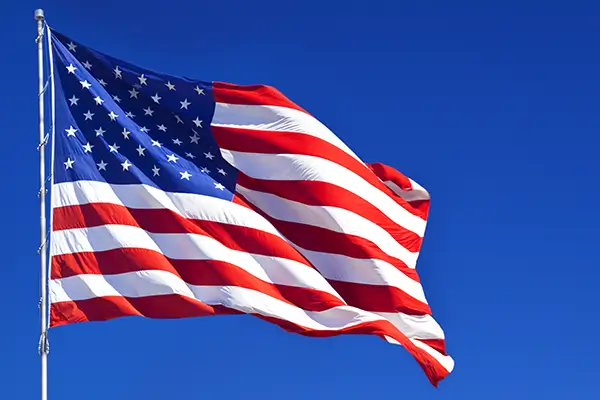
USA Flag— code
-
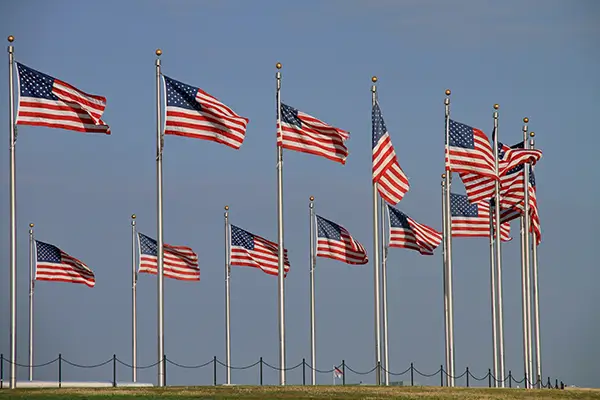
USA Flag— code
-
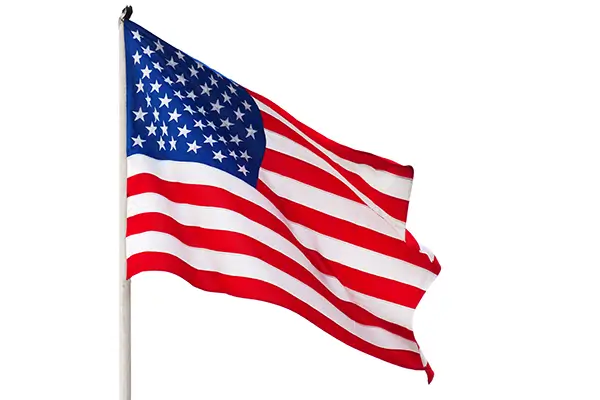
USA Flag— code
-
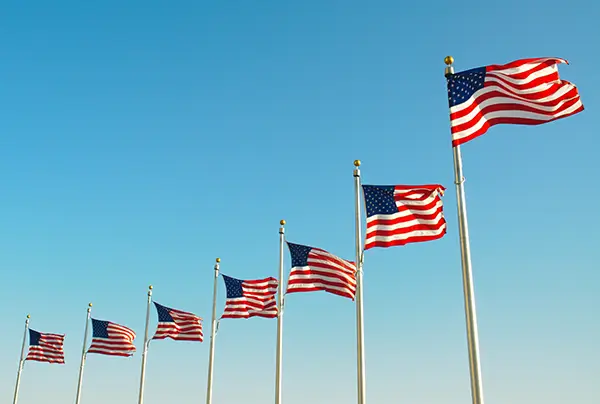
USA Flag— code
-
USA Flag— code
-
USA Flag— code
-
USA Flag— code
-
USA Flag— code
-
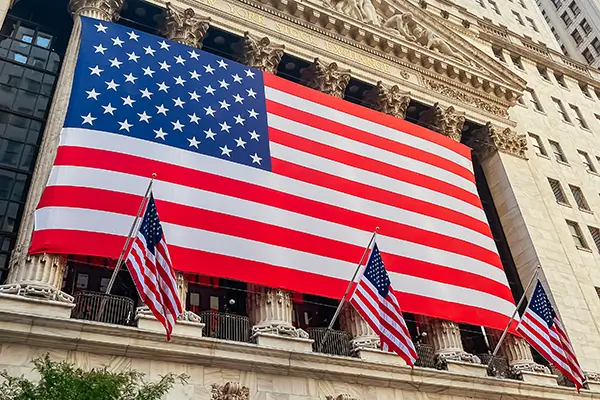
USA Flag— code
-
USA Flag— code
-
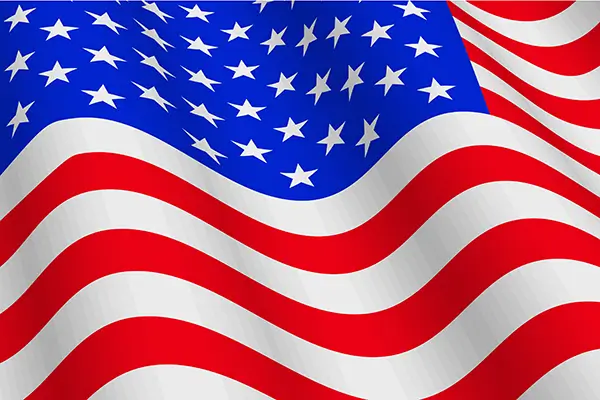
USA Flag— code
-
USA Flag— code
-
USA Flag— code
-
USA Flag— code
DownloadsRequest a high-resolution image
- Browse the images above and tap the code beneath the one you want — it copies to your clipboard.
- In the form below, enter your email and paste the code along with a short note telling us what you need.
- We’ll email you the requested image, usually within a few business days.
Frequently asked questions
When was the American flag adopted?
The first Stars and Stripes was adopted by the Second Continental Congress on June 14, 1777 — now celebrated as Flag Day. The flag has been revised 26 times as states joined; the current 50-star version became official on July 4, 1960, after Hawaii became the 50th state.
What do the stars and stripes mean?
The 50 white stars stand for the 50 states of the Union, and the 13 stripes (7 red and 6 white) stand for the 13 original colonies that declared independence from Great Britain in 1776.
What do the colors of the American flag mean?
No official meaning is fixed in law for the flag itself. The familiar reading comes from Charles Thomson’s 1782 report on the Great Seal: white signifies purity and innocence; red, hardiness and valor; and blue, vigilance, perseverance, and justice.
Who designed the American flag?
The most-cited evidence points to Francis Hopkinson, a New Jersey delegate to the Continental Congress and a signer of the Declaration of Independence, who billed Congress for the design in 1780. The popular Betsy Ross story — that she sewed the first flag in 1776 — was first told in 1870 by her grandson and has no contemporary documentation. The 50-star arrangement was designed in 1958 by Robert G. Heft, then a 17-year-old high-school student.
Why does the flag have 13 stripes?
The 13 stripes honor the 13 original colonies. Early on, both stars and stripes grew as states joined (reaching 15 of each in 1795), but that quickly became unwieldy. The Flag Act of 1818 set the stripes permanently at 13 and added only a new star for each new state.
What are the official colors and proportions of the flag?
Executive Order 10834 (1959) sets the hoist-to-fly ratio at 10:19. Each stripe is one-thirteenth of the hoist, the blue canton is seven stripes tall and two-fifths of the fly wide, and each star is four-fifths as wide as a stripe. The official textile colors are cable Nos. 70180 Old Glory Red, 70001 White, and 70075 Old Glory Blue (often given as Pantone 193 C and 281 C, or about #B22234 and #3C3B6E).
Why is the flag called “Old Glory” and the “Star-Spangled Banner”?
“Old Glory” was the name the Salem sea captain William Driver gave the 24-star flag his mother and Salem friends gave him for his 21st birthday in 1824; it later spread to the flag in general. “The Star-Spangled Banner” comes from the 15-star flag that flew over Fort McHenry during the War of 1812, which inspired Francis Scott Key’s 1814 poem — now the national anthem.
How many versions of the American flag have there been?
There have been 27 official versions. Since the first Stars and Stripes of 1777, the flag has been changed 26 times — almost always to add a star for a new state. The 50-star flag, unchanged since 1960, has flown longer than any version before it.
What is the U.S. Flag Code?
The Flag Code (Title 4 of the U.S. Code) is a set of guidelines for displaying and handling the flag — for example, never letting it touch the ground, illuminating it if flown at night, and placing the union to the observer’s upper left. It is advisory: it carries no penalties for private citizens.
When is Flag Day?
Flag Day is June 14, the anniversary of the 1777 Flag Resolution. President Woodrow Wilson proclaimed it in 1916, and Congress established National Flag Day in 1949.

We Value Your Opinion Comments